
Golf Equipment
Zero-torque putters: did L.A.B. start it, and has Odyssey caught up?
L.A.B. made zero-torque putters impossible to ignore, but it did not invent every balanced-putter idea. The useful question is which design, setup, and fit actually help you start the ball where you aim.
The short answer
No, L.A.B. Golf did not invent every version of a low-torque or zero-torque putter. Putters that align mass with the shaft axis appear in patents going back decades. Axis1 was founded in 2006 and received a U.S. patent in 2011 for a design that aligns the head's center of gravity with the shaft axis. L.A.B.'s self-balancing patent has a 2013 priority date and describes a different geometry built to make the face seek square at a golfer's playing lie angle.
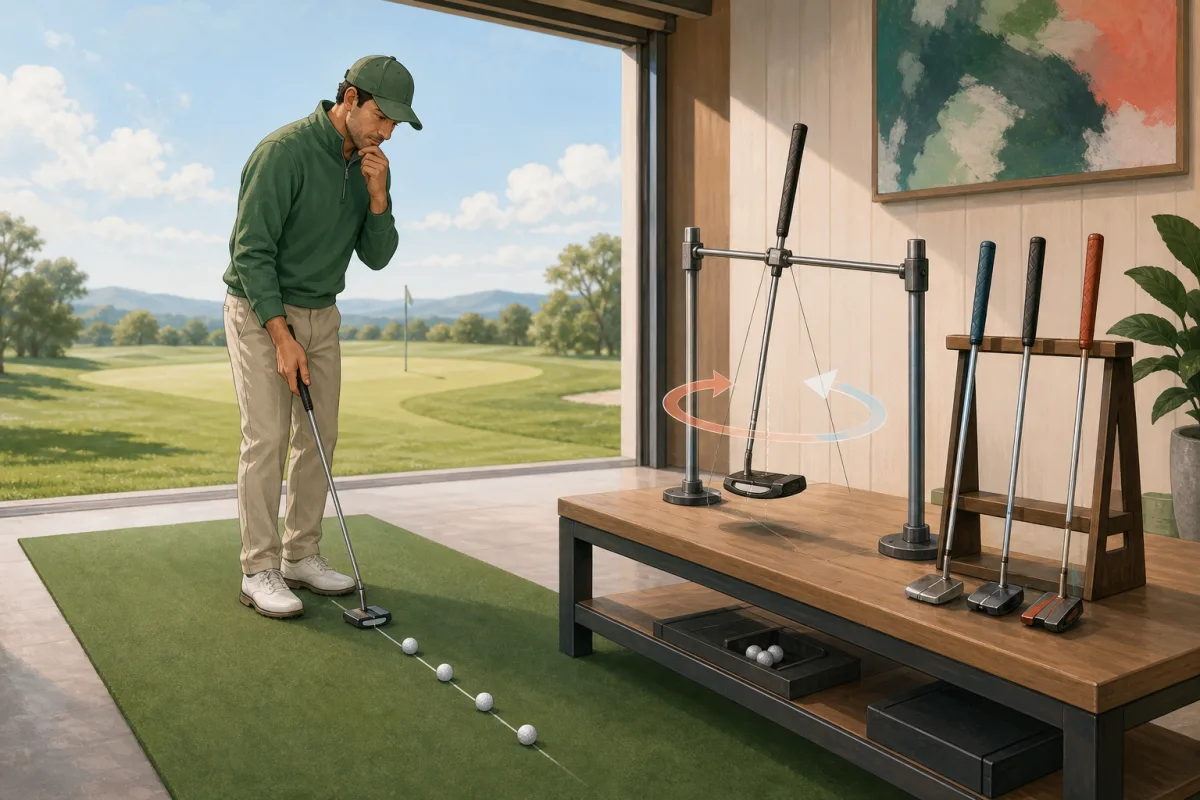
What L.A.B. did exceptionally well was turn Lie Angle Balance into a category golfers could see, test, and talk about. The original shapes were unmistakable, the Revealer demonstration made torque visible, and fitting the putter to a specific lie angle became part of the product story. Odyssey has since brought the idea into familiar mallet shapes through Square 2 Square.
What zero torque is trying to solve
A putter head has a center of gravity, and the shaft gives your hands an axis through which forces reach that head. When the mass sits away from that axis, gravity and motion can create a twisting tendency. Traditional toe-hang and face-balanced putters manage that tendency in different ways. A zero-torque design tries to reduce or remove it by arranging the shaft and mass so the head does not want to rotate away from its balanced orientation.
That does not mean the putter makes the stroke for you. You still have to aim the face, choose a line, control speed, strike the ball, and read the green. It also does not mean every company uses the phrase in exactly the same engineering sense. "Zero torque," "torque free," "Lie Angle Balance," "toe up," and "Stroke Balanced" are related marketing and design descriptions, not one universal specification measured by an independent golf authority.
The promise is narrower and more believable: if the head fights your natural stroke less, returning the face consistently may feel simpler. Whether that helps depends on your aim, setup, delivery, and ability to control pace with the resulting head.
A brief history without awarding one magic trophy
| Date | Documented development | What it tells me |
|---|---|---|
| 1969-1971 | A U.S. patent filing describes a putter with its center of mass aligned with the shaft axis to minimize torque. | The underlying idea predates every current brand in this comparison. |
| 2005-2011 | An Axis1 patent family develops around a shaft axis intersecting the head's center of gravity; the company was founded in 2006. | Axis1 has a credible earlier modern claim than L.A.B. to a commercial torque-free architecture. |
| 2013-2016 | Bill Presse IV's self-balancing putter filing becomes U.S. Patent 9,233,280. | L.A.B. protects a specific lie-angle-balanced geometry, not the abstract idea that balance can reduce twisting. |
| Current market | L.A.B., Axis1, Odyssey, and other makers now offer their own balancing approaches and head shapes. | The category is mature enough to compare by fit and results instead of novelty alone. |
Patents establish dates and specific claims; they do not settle which putter works best for a particular golfer. They also make "everyone copied L.A.B." too simple. Older concepts existed, Axis1 took an earlier modern route, L.A.B. patented Lie Angle Balance, and larger manufacturers later entered a market L.A.B. helped make visible.
How L.A.B., Axis1, and Odyssey differ
L.A.B. balances the putter at its playing lie angle
L.A.B. describes Lie Angle Balance as keeping the face square to the stroke's arc when the putter is held at its fitted lie angle. That fitting matters: length and lie determine where your hands, eyes, and head sit, and the company's custom process balances the finished build around those numbers. Several models also pair with a grip that presets forward shaft lean.
The practical attraction is a head that feels unwilling to fan open or shut. The practical adjustment may be the look, center-shafted address picture, grip, ball position, or forward press. A design can reduce one kind of manipulation while asking me to learn a setup I have never used.
Axis1 aligns the face center, center of gravity, and shaft axis
Axis1 says its design places the center of gravity in line with both the center of the striking face and the shaft and grip axis. Its 2011 patent documents the bent-shaft and weighting approach behind that alignment. This often creates a hosel and head appearance that is different from a conventional plumber's-neck putter.
That visual difference is not a reason to reject it, but aim is not optional. If my eyes tell me the face is pointed somewhere it is not, a beautiful balance demonstration will not rescue the first six feet of the putt.
Odyssey brings the category into familiar shapes
Odyssey's Square 2 Square family uses center-shafted or specially arranged designs that balance toe-up and are intended to stay square to the path. The lineup combines that balance concept with recognizable Odyssey mallet shapes and the company's insert feel.
Has Odyssey "caught up"? It has clearly entered the category with legitimate design choices and a broad fitting footprint. I would not decide technical equality from a product page. L.A.B. balances around a golfer's fitted lie angle, Axis1 makes a specific center-of-gravity claim, and Odyssey offers its own toe-up architecture. The scorecard is aim, start line, speed, and consistency.
Do not buy one from a balance trick alone
A putter hanging square in a fixture is a useful demonstration of how its mass behaves. It is not a full fitting. The following can matter just as much:
- Aim: can you point the face where you think it is pointing?
- Length and lie: can you stand naturally without forcing your eyes or hands into place?
- Loft and shaft lean: does your setup launch the ball into a clean roll?
- Head shape and alignment: does the top line calm you down or make the target look crooked?
- Sound and feel: can you judge a 35-foot putt from the feedback at impact?
- Weight and tempo: does the head help your rhythm or make the stroke feel like a slow argument?
The side-by-side test I would run
I would use the same model of ball and compare fitted lengths as closely as possible. I would also give each unfamiliar setup several minutes before scoring it. The first stroke with a center shaft or built-in forward press mostly measures surprise.
- Five straight putts from five feet. Record makes, but also mark where misses start. This is the face-and-aim test.
- A start-line gate. Put two tees just wider than the ball about a foot in front of the starting point. Count clean passes through the gate.
- A 20-, 30-, and 40-foot ladder. Hit three balls to each distance and measure the worst finish, not only the best one.
- One left-to-right and one right-to-left putt. A head can look easy on a straight line and strange when the target moves away from the face.
- Return to the first five-footer. The second set reveals whether the setup became clearer after speed work.
I would write down four things: start-line success, average finish distance, aim confidence, and setup comfort. A launch monitor or fitting system can add face angle and path data, but the basic comparison already prevents one holed putt from becoming a purchasing philosophy.
Who should try a zero-torque putter?
Try one if you feel the head rotating in your hands, constantly manipulate the face, struggle to return it square, or simply want to learn whether a different balance changes your delivery. It is also worth testing if a fitter can show a repeatable improvement in face angle or start line without destroying distance control.
Do not assume you need one because the category is popular. A conventional putter that you aim well, strike consistently, and control from long range is not obsolete. High moment of inertia helps mishits; zero-torque balance addresses a different problem; fitting connects either design to your body and stroke.
My buying rule
I would not buy a zero-torque putter to join a technology camp. I would buy one if it wins a fair test and still feels natural after the novelty wears off. The best outcome may be L.A.B., Axis1, Odyssey, another balanced design, or the putter already in the bag.
L.A.B. deserves credit for a distinct patented system and for making the category understandable. Axis1 deserves a place in the modern history. Odyssey gives more golfers an accessible way to test the concept. None of those facts can roll my next six-footer. That part still needs the fitting, the drill, and me.
Sources
- U.S. Patent 3,625,517: center of mass aligned with shaft axis
- U.S. Patent 8,016,693: Axis1 golf club
- U.S. Patent 9,233,280: self-balancing putter
- L.A.B. Golf: patent list
- L.A.B. Golf: Bill Presse IV and Lie Angle Balance history
- Axis1: company and founder history
- Axis1: zero-torque design FAQ
- Callaway Golf: Odyssey Square 2 Square family
More from this series
Clubs and Gear Without the Guesswork
Part 5 of 10. Choose a useful bag, ball, scoring club, distance device, and first purchases around the golfer you are now.
Keep reading
Here's another article you can enjoy
How to stop three-putting: the first drill and a practice plan
Separate long-putt speed from short-putt start line, begin with one simple drill, and build a routine for home, the practice green, and the minutes before a round.
So many clubs! What pros carry and beginners actually need
The 14-club rule, wedge gaps, woods, hybrids, putters, and the case for giving every club a job.
Golf club offset: when it helps, when it hurts, and what to buy
Offset can support an open-face miss, but it is only one part of an iron. Here is how to recognize it, test it, and know when your fit deserves another look.