
Golf balls
How to choose a golf ball without overthinking it
The right golf ball is not always the most expensive one. For newer avid golfers, the best ball is usually the one that fits your misses, budget, and short-game priorities.
The simple answer
If you are losing several balls per round, start with a durable value ball from a reputable brand. When you lose fewer balls and notice short-game feel, test a softer or more spin-focused model.
Begin with the cover and construction
Most value balls use an ionomer-style cover that favors durability and lower cost. Many premium balls use a softer urethane cover to create more friction on partial wedge shots. Two-piece balls are generally the simple, durable option; balls with three or more layers give designers more ways to balance driver flight, iron spin, and greenside control.
More layers do not automatically make a ball better for you. They describe how the ball is built, not whether it fits your game.
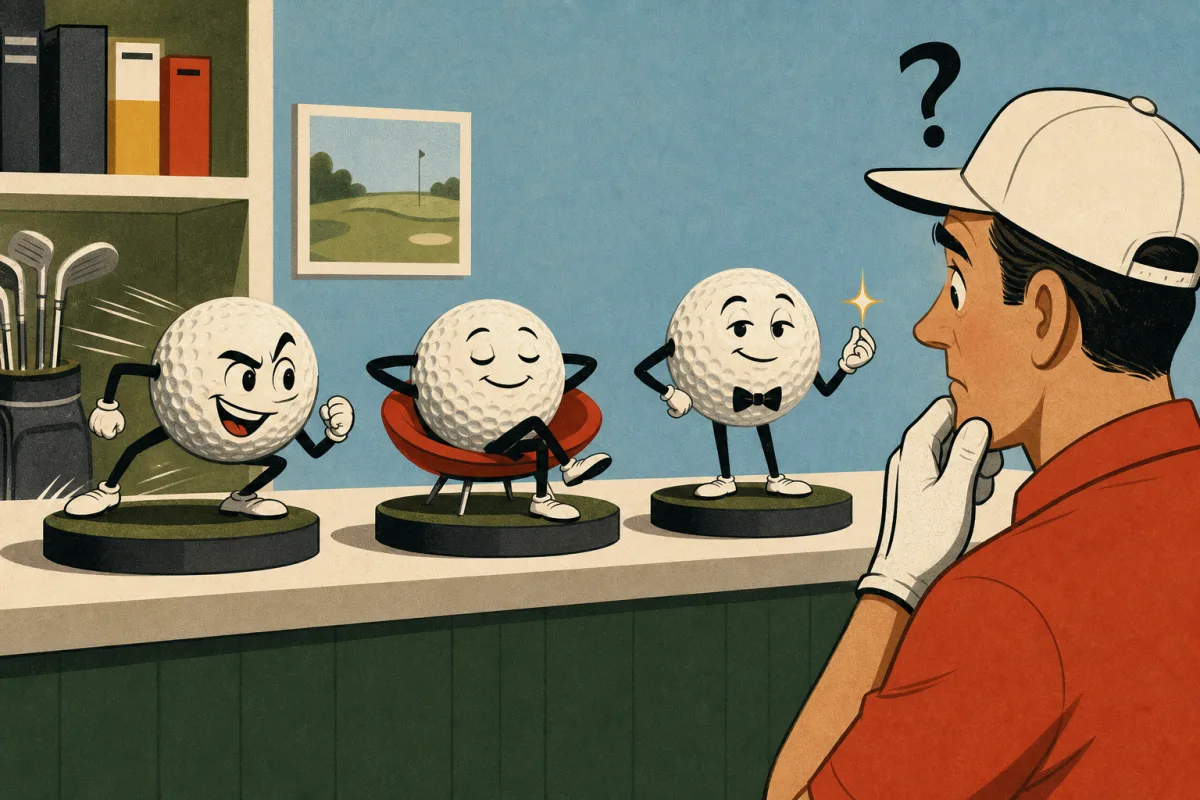
Distance-focused balls
Distance-focused balls usually pair an energetic core with a durable cover to promote a strong flight and keep cost under control. They make sense when your main goals are advancing the ball, reducing side spin, and not wincing every time one disappears into a pond.
Soft feel balls
Soft-feel balls are popular with newer golfers because they feel less clicky on wedges and putts. They can make the game more pleasant, especially when you are still developing contact.
Tour-style urethane balls
Premium urethane balls are designed to combine speed on full swings with more greenside spin and control. That extra response can matter when you deliberately hit pitches and chips that should stop sooner. It matters much less when inconsistent contact is still the largest influence on every shot.
What compression means
Compression describes how much the ball deforms under force. Lower-compression models often feel softer, while higher-compression models often feel firmer. Swing speed can be part of the fit, but cover, construction, temperature, and personal feel also matter. Treat compression as a clue, not a personality test or a rule that forbids you from trying a ball.
Choose for the shots you actually play
If your tee shots curve dramatically, no legal golf ball will replace work on the face and path of the club. A lower-spinning model may soften the result, but contact remains the larger issue. Around the green, differences are easier to judge: does the ball release farther than expected, check after one bounce, or feel too hard off the putter?
For most new golfers, predictable feel and a price that encourages normal swings are more useful than a few theoretical yards.
A beginner buying framework
- Pick a price you can tolerate losing.
- Choose a visible color if tracking the ball is hard.
- Play one model for a few rounds before switching.
- Notice putting feel and wedge check before chasing driver distance.
- Upgrade only when you can explain what the cheaper ball is not giving you.
Run a simple on-course test
Choose two models at a similar price and play them from the same areas during a quiet practice session. Start near the green: hit several short chips, longer pitches, and putts with each. Then compare mid-irons and tee shots. Keep the test practical rather than scientific. You are looking for a ball whose flight and rollout you can anticipate.
Once you choose one, stay with it for several rounds. Changing models every few holes makes it harder to learn whether a shot came from your swing or the equipment.
Do color and condition matter?
A bright yellow or other high-visibility ball can be a sensible choice if it is easier for you to follow in the air or find in rough. Scuffs that are only cosmetic are different from cuts, cracks, or badly damaged covers; retire a damaged ball before it becomes another variable.
Check the rules when competition matters
For casual play, the important thing is using a ball you enjoy and can identify. In competitions where the conforming-ball condition is in effect, the model must appear on the official conforming list maintained by the USGA and The R&A. Manufacturers release variations frequently, so check the current list rather than relying on an old package or article.
The practical recommendation
Buy a dozen durable value or soft-feel balls from a reputable maker, mark them so they are identifiable, and learn their behavior. Move toward a urethane model when greenside control becomes something you can observe and use. The best ball is the one that makes your next shot understandable without making every lost ball feel expensive.
Sources and further reading
Next, see what beginner golf gear is worth buying first or learn how to give every club in the bag a job.
More from this series
Clubs and Gear Without the Guesswork
Part 9 of 10. Choose a useful bag, ball, scoring club, distance device, and first purchases around the golfer you are now.
Keep reading
Here's another article you can enjoy
So many clubs! What pros carry and beginners actually need
The 14-club rule, wedge gaps, woods, hybrids, putters, and the case for giving every club a job.
Golf club offset: when it helps, when it hurts, and what to buy
Offset can support an open-face miss, but it is only one part of an iron. Here is how to recognize it, test it, and know when your fit deserves another look.
How to choose wedge loft, bounce, and grind
A wedge stamped 56 degrees can be a digger, a glider, a bunker specialist, or the most versatile club in the bag. Loft is only the first angle in the decision.