
Gear
Rangefinder vs. golf watch: which should you buy first?
A laser tells you how far it is to the thing you can see. A GPS watch tells you where you are within the hole. Your best first device depends on which question costs you more shots and time.
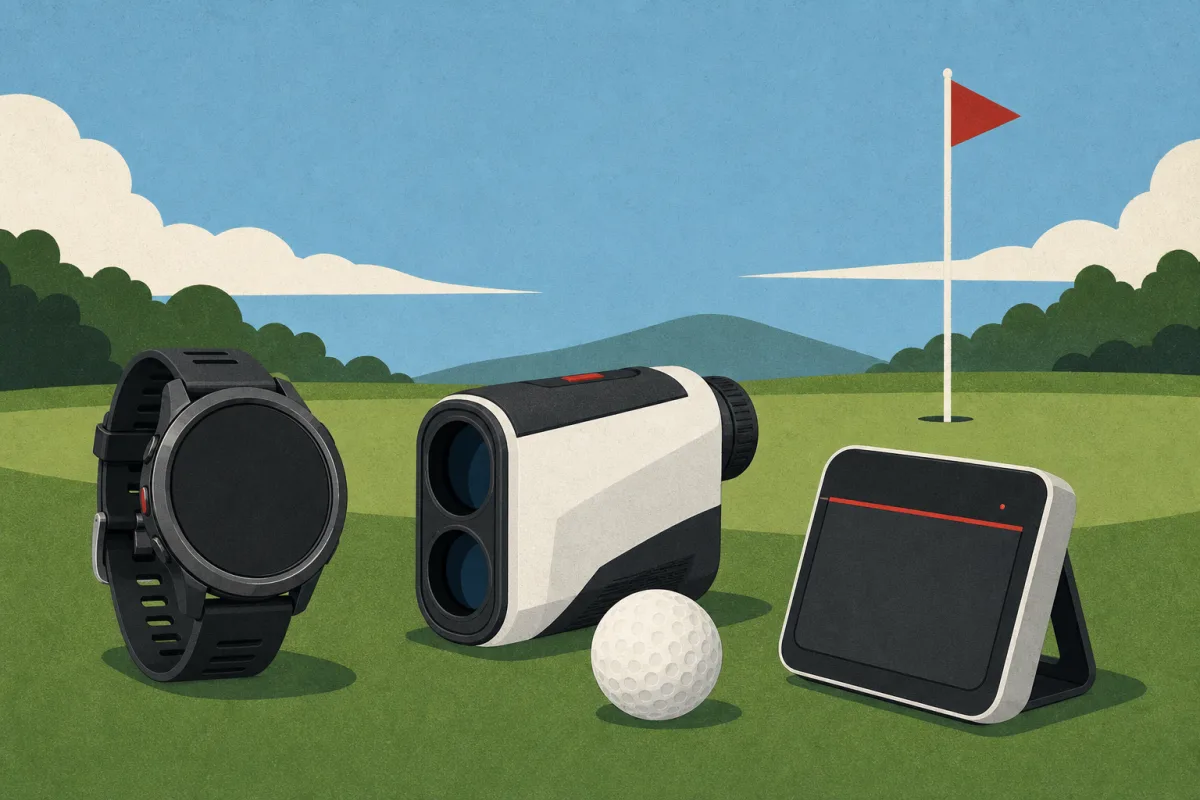
The short answer
Choose a laser rangefinder first if you usually see the target and want one direct number to the flag, bunker lip, tree, or range marker. Choose a GPS golf watch first if you want front, middle, and back green distances at a glance, especially on unfamiliar courses or holes where you cannot see the landing area.
For many newer golfers, broad context is more useful than pin-level precision. Knowing that the front of the green is reachable and the back is trouble can lead to a calmer club choice than knowing the flag is exactly 147 yards away. But if your main frustration is guessing at visible targets, the laser is the cleaner tool.
There is also a responsible third answer: buy neither yet. Course markers, a paper card, or a phone app can teach you whether distance information changes your decisions before you add another device to charge or lose.
What a laser rangefinder actually does well
A laser measures the line-of-sight distance to the object you aim at. That makes it useful for a flag, a tree you need to carry, the face of a bunker, a layup marker, or a target at the driving range. You choose the object, press the button, and get a specific number.
That specificity is the appeal. If the pin is visible and your club distances are reasonably settled, a laser answers the immediate question without asking you to interpret a map. It can also be passed to a playing partner, and it does not depend on a particular course being loaded into a database.
The tradeoff is that you need a visible object and a steady enough aim to isolate it. A laser cannot show the shape of a hidden green or tell you that water wraps around the far side. When trees, fog, a blind rise, or a group ahead blocks the target, the exact-number advantage can disappear.
What a GPS golf watch does well
A golf watch uses your location and a mapped course to provide distance information throughout the hole. The common front-middle-back display is more meaningful than it first appears: it gives you the depth of the green and helps you choose a club for a safe section rather than treating every flag as the only destination. Garmin's official support documentation, for example, explains those three green distances and notes that changing pin positions are why a watch may not show an exact flag location.
The best part is low friction. Look at your wrist, read the shape of the problem, and keep moving. Depending on the device and course data, a watch may also show hazards, doglegs, a movable pin position, scoring, or shot records.
Those extras are not automatic victories. Course maps can be missing or outdated. Shot tracking may require taps, club sensors, or cleanup after the round. Small screens make complex maps less useful, and every connected feature asks for battery, setup, permissions, or attention. Buy the watch for the two or three functions you will actually use, not for the longest feature list.
The comparison that matters on the course
Laser rangefinder
Best for a precise distance to a visible, selectable target. It asks you to stop, aim, and interpret that one number.
GPS golf watch
Best for immediate hole and green context. It asks you to trust the map and keep the device ready for a full round.
Laser limitation
Blind targets and shaky acquisition can slow the process. It does not explain what lies beyond the object you measured.
Watch limitation
The number is tied to a mapped point, not necessarily the flag. Course coverage, updates, and battery all matter.
Which one helps a beginner more?
Start with the decision you are capable of making. If your comfortable 7-iron carry is still somewhere between "about 120" and "occasionally majestic," a laser's exact pin number may imply more control than you have. Front-middle-back guidance can be kinder and more useful: pick enough club to cover the front, favor the safe side, and accept that the target is a green-sized area.
A laser becomes more valuable as your carry distances stabilize and your questions become specific. It is also excellent at the range when the posted target distances are uncertain, provided the range and device permit safe use.
Still, personality matters. Some golfers dislike wearing anything on the wrist. Others will leave a rangefinder attached to the cart and remember it halfway home. The device you can use quickly, without breaking your routine or distracting your group, is the better device.
Are rangefinders and golf watches legal?
Under the current Rules of Golf, players may generally get information on distance or direction from a distance-measuring device. However, The R&A's distance-measuring guidance says the device must not be used to measure elevation changes or interpret information into a recommended line or club selection. A competition committee may also adopt a Local Rule prohibiting electronic distance-measuring devices.
That means a device can contain a slope or "plays like" feature, but you must not access prohibited information during a round played under those Rules. Learn how to disable those functions before the first tee, and check the event's Local Rules rather than relying on what was allowed during last week's casual round.
Simple scorekeeping, actual distance, and pre-existing club-distance information can be allowed while calculated advice based on measured slope, wind, or current-round analysis can cross the line. The USGA's distance-measuring device guide shows common laser, handheld, phone, and watch examples in one useful summary.
What to inspect before buying
For a laser rangefinder
- Can you acquire a flag quickly with your normal hand steadiness?
- Is the display readable with your eyesight and in mixed light?
- Can prohibited slope information be clearly disabled?
- Does the case or cart attachment fit the way you walk or ride?
- Is the battery common, rechargeable, and easy to check?
For a GPS golf watch
- Are your regular courses in the manufacturer's course database?
- Can you read the core yardages without navigating several screens?
- Will the battery comfortably cover your longest golf day?
- Which features work without a phone, subscription, or extra sensors?
- Can plays-like, wind, or club-recommendation features be disabled for competition?
For either device, borrow one for a few holes if possible. A demo tells you more about aiming, screen readability, and annoyance than a specification sheet ever will.
When owning both makes sense
The devices can complement each other. A watch can show that the green runs from 138 to 162 yards and that trouble begins long. A laser can then tell you the visible flag is 149. One provides the map; the other locates the object within it.
That combination is useful for golfers who play varied courses, care about exact targets, and already know how to turn both numbers into a shot. It is not a requirement for serious golf. Distance information should shorten the decision, not create a small electronics meeting beside every ball.
Before adding course technology, make sure the rest of the bag has a job. The first golf purchases guide puts early spending in order, and the 45-ball range plan works with or without a measured target.
Sources and further reading
- The R&A: Distance-measuring devices
- The R&A: Model Local Rule G-5, prohibiting distance-measuring devices
- USGA: Understanding the Rules of distance-measuring devices
- Garmin Support: Front, middle, and back green distances
More from this series
Clubs and Gear Without the Guesswork
Part 7 of 10. Choose a useful bag, ball, scoring club, distance device, and first purchases around the golfer you are now.
Keep reading
Here's another article you can enjoy
So many clubs! What pros carry and beginners actually need
The 14-club rule, wedge gaps, woods, hybrids, putters, and the case for giving every club a job.
Golf club offset: when it helps, when it hurts, and what to buy
Offset can support an open-face miss, but it is only one part of an iron. Here is how to recognize it, test it, and know when your fit deserves another look.
How to choose wedge loft, bounce, and grind
A wedge stamped 56 degrees can be a digger, a glider, a bunker specialist, or the most versatile club in the bag. Loft is only the first angle in the decision.