
Golf Equipment
Golf club offset: when it helps, when it hurts, and what to buy
An offset iron can feel like magic when the face arrives open. Then the swing improves, the miss changes, and the club that helped can become the first suspect. I know this story because I managed to live it.
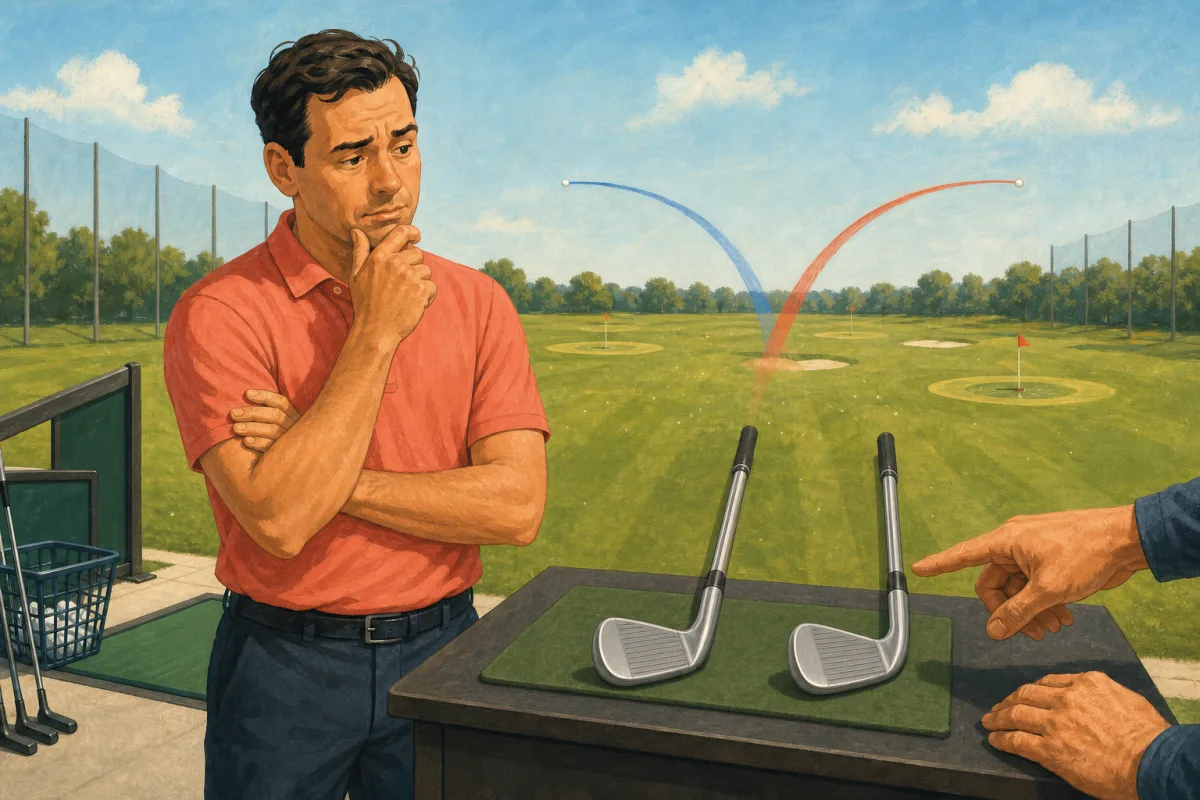
Tell me if this sounds familiar
You are a high-handicap golfer who can swing the club, but something is fundamentally off. Maybe the pressure never moves toward the target. Maybe the face stays open. Maybe the wrists hinge, unhinge, rehinge, and generally conduct business without supervision.
So you get fitted. You hit several combinations while the fitter watches the struggle in high definition. Then the fitter hands you another iron and says, "Try this one. It has more offset."
Magic. The same faulty swing produces a much friendlier ball flight. You hit enough good shots to place the order, the clubs arrive, and you are a happy golfer.
Fast-forward a few months. You have practiced. The face closes more naturally. Your old miss begins exaggerating in the other direction. You try a club with less offset and suddenly nothing looks or feels familiar. What happened?
You may have improved. The fit that supported one delivery may no longer be the cleanest match for the delivery you have now.
The quick answer
Offset is the distance between the forward part of the hosel and the leading edge of the clubface. In an offset iron, the face sits slightly behind the hosel when viewed from above at address.
That geometry can help some golfers deliver a less-open face and can contribute to launch and confidence. It can also change what the club looks like behind the ball. More offset is common in game-improvement irons, but it normally arrives as part of a package that may also include a wider sole, larger head, different center-of-gravity location, stronger or weaker loft, and more perimeter weighting.
If a miss changes after months of improvement, do not declare offset guilty from the parking lot. Check face angle, path, strike, lie, ball position, grip, shaft, and the full head design. Then compare clubs with enough shots to see a pattern.
What offset actually changes
At address, the shaft and hosel appear slightly ahead of the leading edge. During the swing, that relationship changes how the head is presented and where the head's mass sits relative to the shaft. Golfers often describe the result as having a fraction more time to square the face.
That description is useful, but it can become too neat. A golf shot is not produced by offset alone. The face direction at impact, swing path, delivered loft, lie angle, strike location, speed, and turf interaction all matter. The amount of offset is measured in fractions of an inch or a few millimeters, and its effect arrives inside that larger moving system.
There is also a visual effect. Some golfers set a more-offset head down and feel as if the face naturally wants to sit closed. Others see the leading edge behind the hosel and become unsure where square is. A design feature that inspires confidence for one golfer can create alignment gymnastics for another.
Why it felt like magic at the fitting
If my common delivery left the face open, a more-offset game-improvement head could make the resulting pattern more playable. The ball might start closer to the target, curve less to the right for a right-handed golfer, launch more comfortably, or simply come from a head I struck more consistently.
Notice how many possibilities are hiding in that sentence. The fitter did not add offset to the same club while freezing every other variable. I probably changed head shape, sole, loft, shaft, length, lie, weight, and feel at the same time. The new iron may genuinely have fit better, but "offset fixed me" is a much larger conclusion than the fitting proved.
PGA of America fitting guidance describes a proper fit as more nuanced than chasing one launch number. Good fitters combine measurements, ball flight, strike, player preference, and the conditions where the golfer plays. That is the standard I want when a club seems miraculous after a handful of swings.
Why the miss can flip as the swing improves
Suppose my original pattern was an open face with a weak shot to the right. Over time, lessons and practice improve my grip, pivot, wrist conditions, and release. I begin delivering the face less open or even closed.
The old club does not know I changed. A shape that blended nicely with the previous delivery can now combine with the new one to send the ball farther left. The club may also encourage an address picture or hand position I learned to depend on. When I pick up a minimal-offset iron, the visual change alone can make me aim or swing differently.
This does not mean improving golfers must graduate from offset. Plenty of skilled players use some offset, and almost every iron has at least a little. It means the amount, the rest of the head, and the golfer's current pattern should still make sense together.
Offset has been around much longer than game-improvement marketing
The idea is not a modern invention. A 1907 U.S. patent granted to James Govan described a golf-club head with the hosel offset relative to the face. His stated purpose centered on moving metal toward the impact area and improving the qualities of metal clubs, not on using today's handicap labels or promising to erase a slice.
That distinction matters. Club designers have used offset and hosel placement for different reasons across more than a century: mass distribution, appearance, alignment, launch, face delivery, and construction. Modern cavity-back and game-improvement irons made visible offset familiar to many golfers, but the geometry itself predates launch monitors, fitting carts, and product categories.
I would not crown one old patent as the single invention of every modern offset iron. It does show that golfers and clubmakers were experimenting with the relationship between hosel and face while metal clubs were still evolving.
How to tell how much offset a club has
Set the iron down in its normal address position and look from above. Imagine a line along the front of the hosel. The farther the leading edge sits behind that line, the more offset the club has.
Manufacturers sometimes publish offset for every iron in a set, usually in inches or millimeters. The number often changes through the set, with more in the longer irons and less in the shorter irons. When the specification is not published, ask the fitter or compare the heads directly at address.
Do not compare a 7-iron from one set with a 9-iron from another and call the visual difference scientific. Compare the same club number, then check actual loft because two modern 7-irons may be built for very different jobs.
My buying checklist after learning this lesson
- Bring the current clubs. A new iron needs a baseline. I want the fitter to see my normal strike and ball flight with the club I know.
- Describe the miss in ball-flight terms. Does it start left, curve left, begin right, or simply strike poorly? "I hate these irons" is honest but hard to fit.
- Test more than five good swings. I want a normal sample that includes the misses. A fitting should tighten the full pattern, not merely produce one beautiful screenshot.
- Compare dispersion, not only distance. A longer 7-iron is not automatically a better 7-iron. I care about start line, curve, carry consistency, landing angle, and where the bad shots finish.
- Change one thing when possible. Try two heads on the same shaft, or two shafts in the same head, so the comparison teaches something.
- Ask for offset and lie details. More left can come from a closed face, an upright lie, a changed path, a different strike, or several of those together.
- Look through the whole set. The 7-iron may fit beautifully while the long irons show too much offset for my eye or the wedges create an abrupt transition.
- Request a follow-up. PGA of America guidance recommends checking the fit again after the clubs arrive. The finished set should be verified, not treated as an unopened verdict.
Questions I would ask the fitter
- How much offset does this head have compared with my current iron?
- Which part of the new result comes from the head, and which part comes from shaft, lie, loft, or length?
- What happens to my worst five shots with each option?
- Does the offset change progressively through the set?
- Can I hit the same combination from turf, not only a perfect mat?
- If my face delivery changes with lessons, which specification should we recheck first?
A fitter should be able to explain the trade without turning one feature into a cure. The goal is not zero offset. The goal is a club I can aim, deliver, and grow with while accepting that another check may be useful after the swing changes.
Do I need new irons right now?
Not necessarily. Before replacing a set, I would confirm the pattern over several sessions and one or two rounds. I would check setup and ball position, use face spray or impact tape to see strike, and ask a coach whether the swing change is stable enough to fit.
If the irons are adjustable, a professional may be able to check or alter lie and loft. Offset is built into the head and is not a normal bend-the-club adjustment, so changing it usually means changing the head. That makes diagnosis especially valuable before spending money.
I would also keep the current clubs during the comparison. Golf is very good at producing a two-week miss and convincing me it is a new identity.
Beware of the offset, but do not fear it
The fitted irons were not a mistake simply because I improved. They helped make golf more playable at a stage when I needed help. The mistake would be pretending that one fit describes my swing forever, or building increasingly strange compensations around equipment I no longer understand.
Offset is a tool. It can support an open-face pattern, launch, strike, and confidence. It can also look wrong or blend poorly with a delivery that has changed. I want to know how much I am looking at, test it alongside the other variables, and buy the pattern rather than the promise.
Do not be like me and discover the design only after your miss changes sides. Do better. Look down at the club, ask the question, and make the fitter explain what the helpful little bend is actually doing.
Sources and further reading
- Google Patents: James Govan's 1907 golf-club patent
- PGA of America: Getting the most out of a fitting experience
- PGA of America: Good fits make for good golf
- PGA of America: Understanding how the clubface works
- USGA: History of equipment rules
More from this series
Clubs and Gear Without the Guesswork
Part 2 of 10. Choose a useful bag, ball, scoring club, distance device, and first purchases around the golfer you are now.
Keep reading
Here's another article you can enjoy
So many clubs! What pros carry and beginners actually need
The 14-club rule, wedge gaps, woods, hybrids, putters, and the case for giving every club a job.
What to buy after your first great range session
The early upgrades that help most, plus the purchases that can wait until your swing settles.
How to make range practice feel like golf: a 45-ball plan
Turn one bucket into targets, club changes, simulated holes, consequences, and a useful note for next time.