
Golf Equipment
Your friend in the golf game: MGI, Alphard, and electric push carts
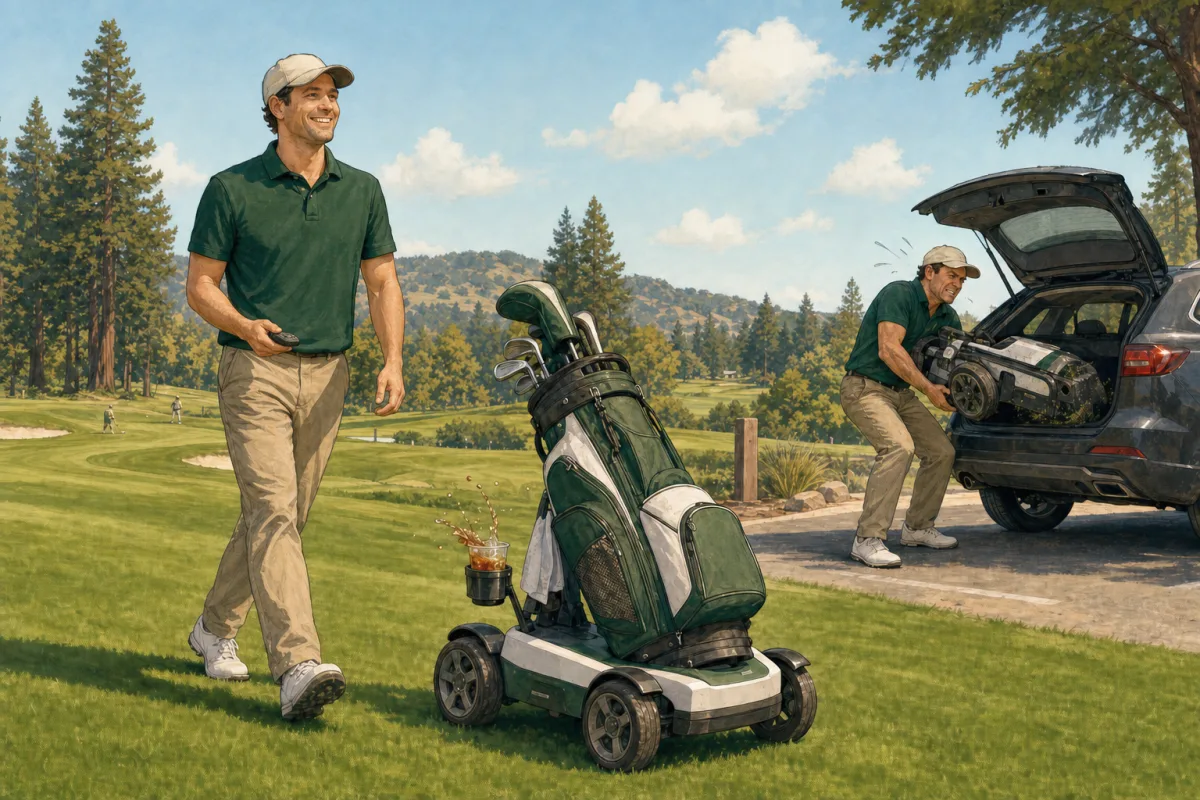
My electric push cart makes walking a golf course feel wonderfully easy. Then the round ends, the wheels stop, and I have to lift nearly forty pounds of grass-covered machine into my car. This is the full relationship.
The quick answer
If I want an integrated machine that is ready to roll, a dedicated remote cart such as my MGI Zip Navigator AT is the cleanest choice. If I already own a push cart I like and want to spend less, a conversion motor such as an Alphard Club Booster deserves a serious look. A follow-me cart adds another layer of hands-free convenience, but it also adds cost and does not remove the need to watch the machine.
The best choice is not simply the cart with the longest feature list. It is the one I can fit in my trunk, lift without regret, keep clean, charge reliably, and control on the actual hills and paths where I play.
Why my MGI feels like a friend on the course
I own the MGI Zip Navigator AT All-Terrain Electric Golf Cart Bundle sold through Costco. The name is long. The walking is easy.
I press a button on a small remote and the cart moves my bag while I walk beside it. I am not pushing the full load up a hill, pulling it over uneven ground, or carrying it on my shoulders. I can simply walk toward the next shot with my clubs following along.
This thing really zips. It is fast, balanced, and willing to climb. The battery has been excellent in my use; I can play multiple rounds before I need to charge it again. That is my experience, not a promise about every course or battery. Hills, turf, load, temperature, speed, battery age, and the length of the round all get a vote.
The biggest benefit is not a launch-monitor number. It is how natural the round feels. At a cart-path-only course, a riding cart can leave me guessing which clubs to carry across the fairway. The electric cart takes the walking route with me, so the entire bag arrives at the ball.
The remote does not run on magic
Remote control creates freedom, not immunity from consequences. A bunker is still a bunker. A curb is still not my friend. Both are survivable if I pay attention, but neither should become part of the planned route.
I keep the cart close enough to see the terrain, slow it before turns or uneven ground, and stop it before I become distracted by somebody else's shot. Side slopes deserve more respect than straight climbs because a tall bag can shift the balance. Bridges, parking areas, other golfers, water, and the edge of a green are all places where I want a hand near the controls and my brain participating.
Then there is the drink holder. An open cup and a fast electric cart create a very efficient beverage-distribution system. The cart will carry the drink. It will not negotiate with the bump that sends the drink elsewhere. Use a lid.
I removed the attachments, and that explains my priorities
The bundle came with useful attachments. I tried the accessory life and eventually removed everything I could. This is not because the holders failed. It is because every extra piece has to fit in the car, clear the folding parts, avoid catching on the storage bag, and survive the trip home.
I chose compactness. The cart folds and the rear wheels can be adjusted to reduce its footprint, but it is still a substantial object. Removing the attachments makes the routine simpler and gives me fewer pieces to clean, tighten, lose, or discover sideways in the trunk.
That choice also means the cart no longer protects me from my own open drink. I accept responsibility for this outcome.
The hidden work begins after the eighteenth hole
Costco lists my bundle at 37.3 pounds. In real ownership language, with the battery installed and the cart awkwardly folded, it feels like roughly forty pounds of machine that does not particularly care how tired I am.
The weight is manageable for me, but the shape matters as much as the number. A dumbbell has a convenient handle and no loose wheels. An electric golf cart has a frame, battery, moving parts, and several opportunities to bump a shin or catch the edge of the trunk.
Grass also gets everywhere. The wheels collect it. The lower frame collects it. The folding joints appear to maintain their own small ecosystem. I use the supplied bag mainly to keep my car and home clean, not because the cart becomes elegant luggage once zipped inside. It can still be unruly.
My routine is simple:
- Brush or wipe off loose grass before loading when possible.
- Power the cart down and remove or secure the remote.
- Fold it in the same order every time and set the wheels for the smallest practical footprint.
- Lift with a deliberate grip rather than grabbing whichever bar is closest.
- Let damp parts dry before long-term storage.
- Charge on a stable, dry setup according to the instructions for the battery.
The cart makes walking easier and then quietly asks me to become stronger so I can transport it. That strength may help my swing too, which means I am choosing to classify the MGI as workout equipment.
MGI versus my friend's Alphard setup
My buddy uses an Alphard Club Booster V2, a motor unit that replaces the rear-wheel section of a compatible push cart. He likes it. It gives him the same important result: his clubs move under remote power while he walks.
The conversion route can cost less than buying a complete dedicated electric cart, especially if the push cart I already own is a good match. Compatibility is the entire sentence hiding behind that word if. My friend's Clicgear was not the pairing he wanted long term, so he eventually bought the Alphard cart designed to work more naturally with the motor.
That is not a failure of the idea. It is the lesson. A conversion kit is a system made from two products. I need to confirm the exact motor generation, brackets, wheel position, folded shape, handle controls, and the specific cart model before buying. A bargain becomes less of a bargain if I replace the base cart afterward.
His setup works well and does the job for less. Mine is faster.
This is not the conclusion of a controlled speed trial. It is an important fact in the friendly competition between two golfers who both like their machines.
Dedicated, conversion, follow-me, or manual?
| Type | Best reason to choose it | Question to answer first |
|---|---|---|
| Dedicated remote cart | One integrated machine with a remote, battery, frame, and stability system designed together. | Can I lift, store, and transport the complete cart comfortably? |
| Conversion motor | Motorize a push cart I already own and potentially spend less. | Is my exact cart genuinely compatible, including when folded? |
| Follow-me cart | The cart can track the golfer without constant remote input in appropriate conditions. | Is the extra convenience worth the price, and where will I still use manual control? |
| Manual push cart | Lower cost, lower weight, no charging, and a simpler ownership routine. | Do I actually need a motor, or do I mainly need wheels? |
I have hands-on experience with the dedicated MGI and direct feedback from my friend about his Alphard conversion. I have not personally owned a follow-me cart, so I treat follow mode as a feature to test rather than a guaranteed upgrade. It sounds luxurious. I would still want to see how it behaves on my course before spending for it.
My electric push-cart buying checklist
- Lift the actual weight. Do not stop at the specification. Pick up the folded cart and imagine doing it after eighteen holes.
- Measure the trunk. Check the cart with the wheels in its smallest configuration, then account for the golf bag, shoes, cooler, and everything else that apparently needs to travel.
- Test the fold. A compact number is less useful if achieving it requires removing several awkward pieces in a parking lot.
- Check bag fit. A stand bag, cart bag, and oversized grip arrangement can sit differently. Make sure the bag stays secure and does not interfere with wheels or controls.
- Study the home course. Steep side slopes, bridges, curbs, wet turf, cart-path restrictions, and storage at the clubhouse all matter.
- Ask about the battery routine. Learn realistic range, charging time, replacement cost, storage guidance, and what the cart is like to push if power runs out.
- Verify parts and compatibility. Remotes get misplaced. Brackets differ. Batteries age. A conversion kit may change with product generations.
- Price the whole setup. Include the base cart, conversion brackets, accessories, storage bag, replacement battery, and any cart I may buy after discovering compatibility is merely theoretical.
- Plan the cleanup. Decide where grass, mud, damp wheels, and the charging cart will live before bringing them home.
What I would test before buying
If a store, demo day, friend, or course gives me the opportunity, I want a very specific test. I would mount my own golf bag, unfold and fold the cart without coaching, lift it into the vehicle I actually drive, and use the controls at slow and fast speeds.
On grass, I would try a straight climb, a controlled descent, a gentle side slope, a tight turn, and a complete stop. I would listen for rattles and watch whether the bag rotates or the front end wanders. I would not launch the demonstration model over a curb or into a bunker in the name of journalism.
For a conversion kit, I would confirm the exact push-cart model and bracket set in writing before ordering. For follow mode, I would test how easily the cart switches between following, remote control, and hands-on steering. For every category, I would ask what happens when the battery is empty and I am still on the far side of the course.
Who should choose which cart?
Choose a dedicated remote cart when...
I want the most integrated setup, regularly walk full-size courses, have room to store it, and can handle the lifting weight. This is where my MGI fits.
Choose a conversion motor when...
I already own a compatible push cart I genuinely like, want remote power for less money, and have checked how the complete system folds and travels. This is where my friend's Alphard started, with the useful warning that the base-cart relationship matters.
Pay more for follow mode when...
I have tested it on terrain similar to my regular course and the hands-free behavior feels meaningfully better than using a remote. I would not pay the premium based on a beautifully flat demonstration alone.
Stay manual when...
Storage, lifting, charging, budget, or simplicity matters more than removing the pushing effort. A good manual push cart is not the lesser answer. It may be the smartest object to own.
Would I buy my MGI again?
Yes.
I love how easy it makes walking a course. The battery has been excellent for me. It is quick, balanced, capable on hills, and always ready to make my friend's Alphard look slightly slower. The cart has become part of how I like to play.
I also know the full ownership story now. It is heavy. Grass finds every corner. The storage bag protects my car and home more than it civilizes the machine. I removed the attachments to make the package as compact as I could. I watch the terrain, keep it out of traps, approach curbs carefully, and no longer expect an open drink to survive the ride.
The right electric push cart feels like a friend in the golf game because it keeps the clubs with me and lets me enjoy the walk. Just remember that even the best friend may need to be carried to the car.
More from this series
Clubs and Gear Without the Guesswork
Part 8 of 10. Choose a useful bag, ball, scoring club, distance device, and first purchases around the golfer you are now.
Keep reading
Here's another article you can enjoy
Walking vs. riding: is there a golf-cart culture war?
Walking has benefits, riding is fun, and moving the bag may be the real question.
Strength training for golfers: a two-day workout
Simple full-body sessions for golfers who want more reserve, speed potential, and durability.
So many clubs! What pros carry and beginners actually need
The 14-club rule, wedge gaps, woods, hybrids, putters, and the case for giving every club a job.