
Golf adventures
Walking vs. riding in golf: is there a cart culture war?
Walking is good for you. Riding is very fun. Carrying clubs can turn either opinion into a completely different argument by the back nine.
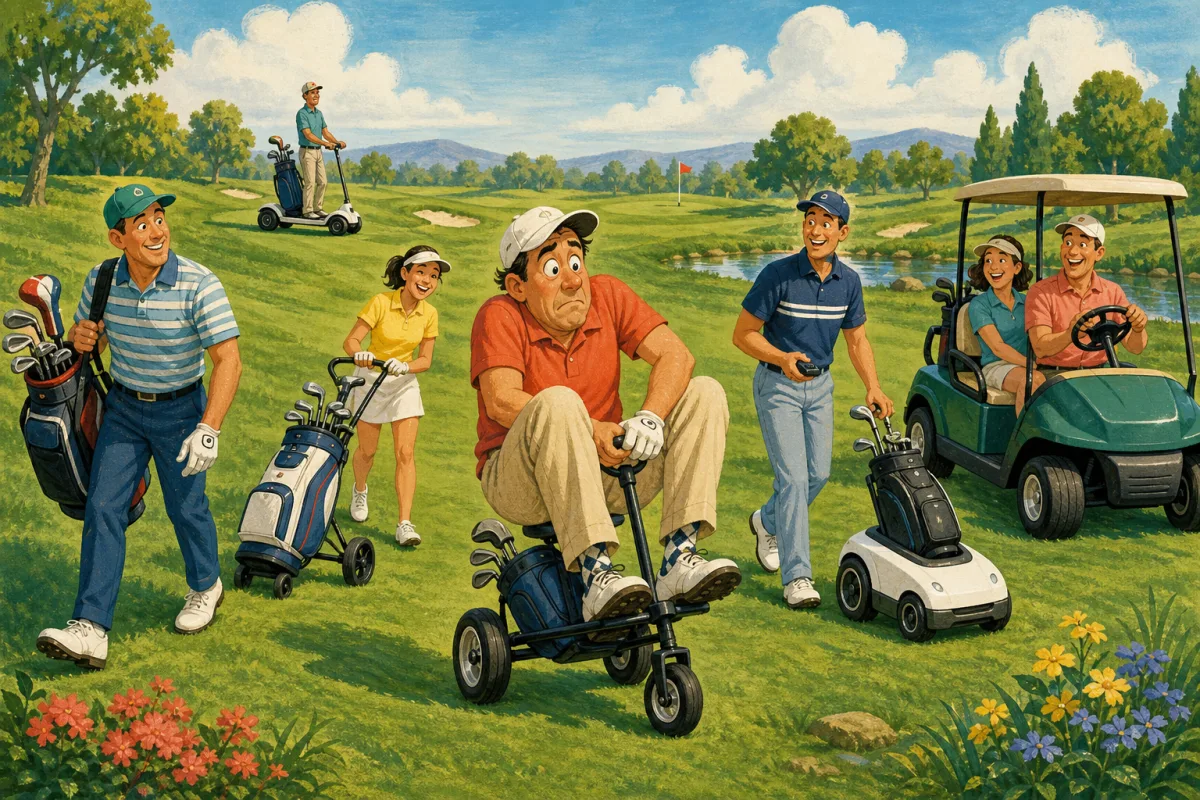
Golfers can become strangely tribal about how everyone gets from one shot to the next. Walking is pure. Riding is lazy. Carrying is traditional. Push carts are sensible. Electric carts are cheating at walking. None of this survives contact with a hot day, a hilly course, a sore shoulder, or the seventh hole when the snack supply has become a strategic emergency.
I enjoy walking. I also enjoy riding. When I was starting golf, riding felt necessary because an 18-hole walk could leave me too tired to play anything resembling golf. As I became more comfortable, walking became part of the experience rather than an obstacle.
That change did not make me morally superior. It made me a golfer who now owns a remote-controlled push cart and still gladly takes a riding cart when the day calls for one.
The quick answer
Walking is usually the better choice when you enjoy it, the course supports it, the weather and terrain are reasonable, and your body is ready for the distance. Riding is better when it makes the course accessible, preserves enough energy to play, suits the property, or simply makes the day more fun.
Carrying, pushing, using an electric caddie, and riding are not measures of commitment. They are ways to move a person and a surprisingly inconvenient collection of clubs around several miles of grass.
My favorite courses to walk
Golden Gate Park Golf Course is an easy yes for me. It is a short, renovated par-3 course, and walking is part of its relaxed rhythm. The same is true for almost any nine-hole course: the distance feels approachable, the round keeps moving, and I am not negotiating with my legs for an entire afternoon.
I have walked Lincoln Park every time I played it. It is hilly, but honestly, it is not that bad for me. The views and changes in elevation make the walk feel like part of the course rather than dead space between shots.
Harding Park is also a great walk. The course is long enough to feel substantial without requiring impossible transitions between holes, and walking lets me move directly toward my ball with the clubs beside me.
Harding Park explains why riding is not always less walking
TPC Harding Park is cart-path-only at all times. If I ride and hit my ball to the opposite side of the fairway, the cart stays on the path. I then trek across with several clubs, hit the shot, and trek back. Depending on the location of everyone's golf balls, this can become a shuttle service with surprise hiking.
My MGI Zip Navigator, purchased through Costco, solves that problem neatly. It is an electric cart for my golf bag, controlled with a small remote. I press forward, reverse, left, right, or change the speed, and the cart moves without me pushing it. Yes, that is the point. The obviousness is also what makes it delightful.
MGI describes the current Zip Navigator as a full-directional remote caddie with straight-tracking and downhill speed-control features. Mine keeps the bag on my walking line so I can go directly toward the ball instead of returning to a paved path after every shot.
It still needs attention. It is not autonomous, it does not read bunkers as danger, and the remote does not excuse me from steering. But it removes the effort of pushing a loaded cart while preserving the part of walking that I like.
Carrying changes the argument
Walking and carrying often get bundled into one choice, but they are not the same. Carrying puts the full bag on your shoulders for the entire round. A manual push cart moves that load to wheels. An electric caddie moves it with a motor.
That distinction mattered when I was building enough stamina for 18 holes. I could enjoy the walk much more when carrying the clubs was removed from the equation. A push cart or electric cart can be the difference between “I do not want to walk” and “I do not want to carry 25 pounds for four hours.”
It also makes club access simple. My whole bag stays with me, which is especially useful on cart-path-only courses. No guessing whether I need the 7-iron, 8-iron, wedge, or the club reserved for quietly returning the ball to civilization.
Fuel is a transportation mode
No matter how I travel around the course, I need drinks and snacks to survive 18 holes comfortably. My personal setup includes plenty of water, Gatorade or another electrolyte drink, and food I will actually eat before I become tired enough to make every decision worse.
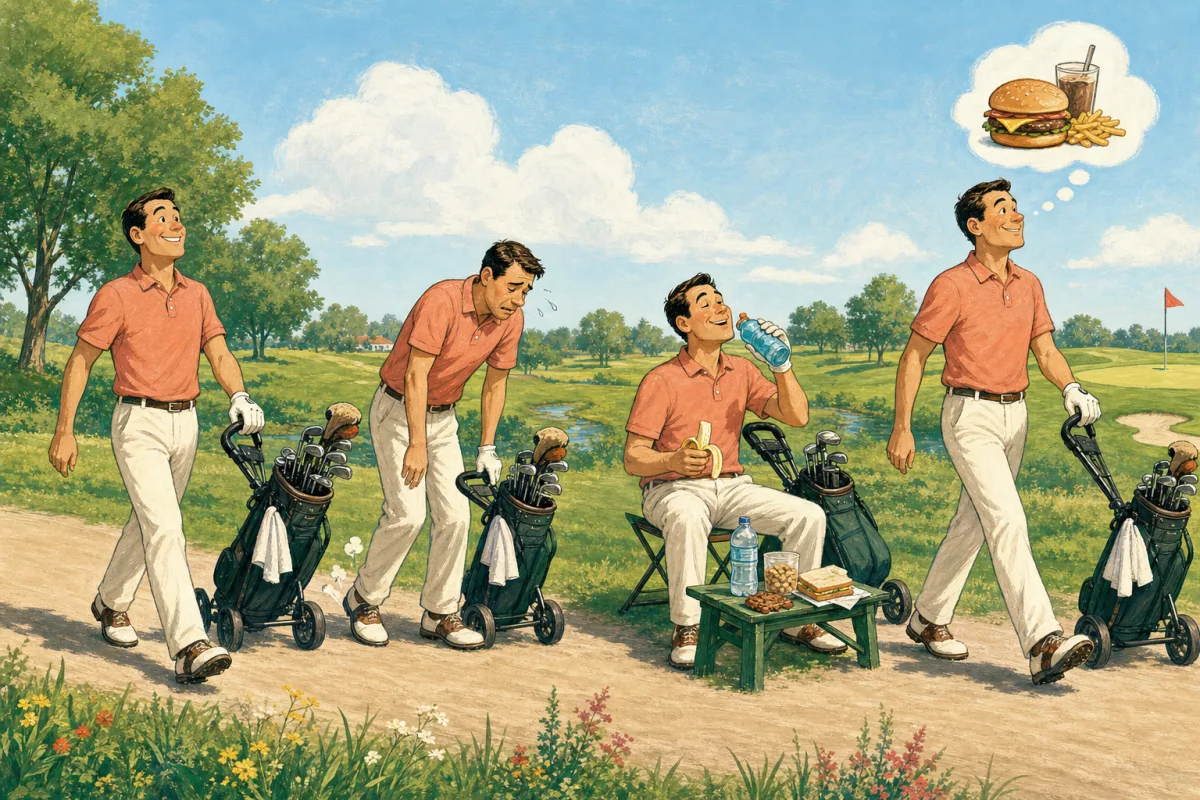
For me, the pattern is predictable: cheerful at the first tee, bargaining with gravity by hole seven, revived at the turn, and hungry again when the round ends. Waiting until I feel depleted is not a clever pacing strategy.
Hydration and fueling needs vary with the golfer, duration, heat, exertion, and health. The American College of Sports Medicine notes that carbohydrate-electrolyte drinks may be useful during exercise lasting longer than an hour, while plain water can be sufficient for shorter activity. This is not a prescription for a particular drink; it is permission to plan ahead instead of trusting a single warm water fountain.
The guilt trip: what to tell friends who want to ride
Here is the playful case for walking. Research comparing experienced golfers in tournament-style rounds found that walkers took substantially more steps and used more activity energy than riders. More broadly, the CDC says regular physical activity supports heart health, sleep, mood, bone health, balance, and long-term disease prevention.
So yes, walking can turn a round into meaningful physical activity. You can tell your friends that the fairway is calling, the step count awaits, and their future selves may thank them.
Then stop. That is the entire guilt trip.
If a friend is tired, injured, managing a health condition, dealing with heat, or simply wants to ride, get in the cart and enjoy the round. The goal is more golf together, not winning a wellness argument beside the bag drop.
There are more than two choices
Carry
The simplest equipment setup and the most load on your body. Best when the bag is light and carrying feels good.
Manual push cart
Keeps the full bag nearby without putting it on your shoulders. Affordable, uncomplicated, and still requires pushing.
Remote electric caddie
Preserves the walking route while a motor moves the bag. More expensive, heavier to transport, and dependent on charging and attentive steering.
Riding cart
Useful for access, heat, distance, pace, difficult terrain, or pure fun. Cart-path rules can create extra walking across fairways.
Some courses also offer single-rider vehicles such as Finn scooters or GolfBoards. I have not tried either one, so I am leaving the dramatic lean-and-ride review to someone who has. They look fun, but availability and course rules decide whether they are a real option.
Choose for the course and the day
- Walk when the route is friendly, the weather cooperates, and the walk adds to your enjoyment.
- Use a push cart when carrying the clubs is the part you dislike.
- Use an electric caddie when you want the walking experience with less pushing and can manage the cost, weight, charging, and controls.
- Ride when it helps you play, helps you finish, or is simply the version of the day your group wants.
- Check the course rules before bringing any motorized or unusual device.
I no longer see walking and riding as opposite camps. They are tools. My favorite choice right now is walking beside the MGI because the bag does the driving and I get the course at ground level.
But if a friend pulls up in a riding cart with cold drinks and an empty passenger seat, the culture war may experience an immediate ceasefire.
Sources
- TPC Harding Park: cart-path-only policy
- MGI: current Zip Navigator specifications
- Sports Medicine: walking versus riding in tournament golf
- CDC: health benefits of physical activity for adults
- American College of Sports Medicine: exercise and fluid replacement
- Finn Scooters: single-rider golf cycle
- GolfBoard: single-rider course transportation
More from this series
Golf Adventures
Part 7 of 7. Plan memorable public-golf days and trips without losing sight of the people, walking, weather, and real-world budget.
Keep reading
Here's another article you can enjoy
Planning a Bandon Dunes golf trip
Courses, walking, weather, caddies, travel, and the budget conversation every group needs.
How I would plan a public golf trip to Monterey
Start with Poppy Hills and Pacific Grove, compare membership value, and choose one Monterey splurge without turning the trip into a financial endurance event.
How to travel with golf clubs: check them, ship them, or rent?
For a special golf trip, I want my own clubs. I compared shipping ahead with borrowing a hard case, checking the bag, and accepting rental clubs.