
Practice
How to make range practice feel like golf: a 45-ball plan
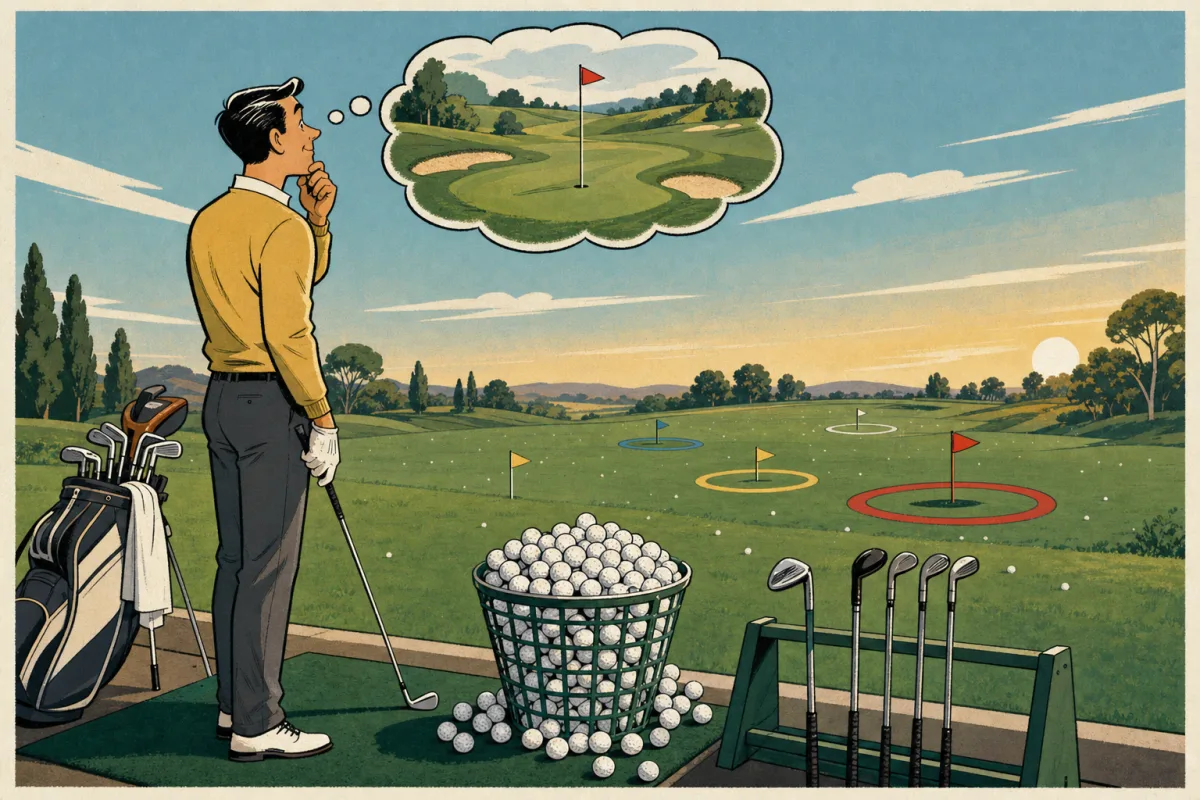
A bucket of balls can disappear without teaching you much. Add targets, club changes, decisions, and a little consequence so the work starts to resemble the game.
The quick answer
Divide the bucket into two kinds of work. First, use a short block of repeated shots to warm up or work on one specific skill. Then switch into play mode: choose a target, change clubs, follow your routine, hit one ball, and accept the result before making the next decision.
That second half is what makes practice feel like golf. The range removes uneven lies, hazards, score, and the walk between shots. You cannot recreate all of that from one patch of turf, but you can recreate the part where every ball asks a new question.
Why a good range swing can disappear on the course
Repeated shots give you advantages you rarely get during a round. The lie stays familiar. The target does not move. You can rake another ball over before the last one has landed, and a poor swing can be erased immediately by a better one.
On the course, there is one ball. You choose a club, aim, wait your turn, manage doubt, and live with the outcome. A useful range session should therefore do more than produce a streak of pleasant contact. It should include some practice at starting over.
Give every shot a clear target
Do not aim at the general middle of the range. Pick a flag, the left edge of a target green, a tree trunk in the distance, or a narrow window between two markers. Then create a reasonable landing zone around it. The target should be precise; the standard for a playable shot should be realistic.
This is not just a Golf Onset preference. PGA of America coaches recommend changing targets and practicing a routine instead of sending most of the bucket toward one central marker.
Before each ball, say the shot in plain language: "7-iron to the right half of the green" is a plan. "Hit it better" is a complaint wearing golf shoes.
Change clubs, but keep one job at a time
On the course, you rarely hit the same club ten times in a row. Rotate through a tee club, mid iron, wedge, and pitch so each swing begins with a fresh setup and intention. Changing clubs also exposes small habits that a groove can hide, such as standing too close with longer clubs or letting the ball position drift.
There is still a place for repeated shots. If a coach gave you a setup change, or you are learning a 40-yard wedge, hit enough balls to understand it. Just do not confuse that workshop with a round. Once the movement is familiar, test it by changing the club or target.
Use the same pre-shot routine you want on the course
A routine does not need to be elaborate. Stand behind the ball, choose the start line and landing area, make one purposeful rehearsal if you need it, set the clubface, settle your feet, look once more, and swing. If the plan feels wrong after you step in, back away and restart.
The routine should create commitment without creating a traffic jam. The USGA's pace-of-play guidance recommends keeping the routine short, being ready when it is your turn, and aiming to play in about 20 seconds once it is time to act. Practicing that rhythm at the range makes it more likely to survive the first tee.
Play imaginary holes with honest consequences
Choose a hole you know, or invent a simple one. Define a fairway between two range markers and a green around a flag. Hit the tee shot once. Its finish determines the next ball:
- A playable drive earns a normal approach.
- A drive that misses your fairway means a recovery club or a safer target.
- An approach that misses the green creates a pitch to a shorter target.
- A ball that would be lost or blocked by trouble costs a penalty in your practice score.
You do not need a launch monitor to make this useful. Estimate where the ball finished and make a reasonable decision. The value is not a perfectly accurate imaginary score; it is choosing the next shot from the result you produced.
A PGA of America course-simulation plan uses the same basic idea: visualize a familiar hole, play to a designated target, estimate the next distance, and complete the normal pre-shot routine for each ball.
A practical 45-ball range session
A medium bucket is enough. More balls often create more rushing, not more learning.
- 10 balls: arrive. Hit three easy wedge shots, three fuller wedges, two mid irons, and two smooth tee shots. Notice contact and balance without grading the session yet.
- 10 balls: build one skill. Choose one job, such as start line with a 7-iron or carry control with a wedge. Keep the target and intention stable long enough to learn something.
- 20 balls: play ten holes. Alternate a tee shot and an approach. Change clubs and targets every ball. When a tee shot would force a recovery, make the next shot a punch or layup instead of granting yourself a perfect fairway lie.
- 5 balls: finish under consequence. Pick a fairway corridor and a green. Your goal might be three playable shots out of five. Stop when the five are gone; there are no free retries.
Use fewer balls if fatigue changes your balance or tempo. A clean 30-ball session is more useful than dragging yourself through the bottom half of a jumbo bucket.
Keep score without turning practice sour
Use a simple three-point result:
- 2 points: the ball finishes in the intended zone.
- 1 point: the shot is imperfect but clearly playable.
- 0 points: the result would require a recovery, penalty, or reload.
Track only the simulated part of the session and compare the total with your own previous attempt. This rewards useful misses, which are a large part of real golf, without pretending a range flag is an exact green.
Make the range conditions part of the lesson
Range balls, mats, wind, and uncertain flag distances all affect the feedback. Treat the printed yardage as an estimate unless the facility has verified it. On mats, pay extra attention to strike sound and ball flight because the surface may hide a slightly heavy shot. If the wind is strong, score start line and curve rather than obsessing over final distance.
You are trying to learn your pattern, not certify a yardage chart. Save precise carry testing for reliable balls, measured targets, or a well-calibrated launch monitor.
Leave with one note, not twelve swing thoughts
Before you go, write down three things: the shot that held up best, the miss that appeared most often, and one job for next time. For example: "Wedges started on line. Driver missed right. Next session: check driver alignment, then play the same ten holes again."
That note gives the next bucket a beginning. The goal is not to make the range indistinguishable from the course. It is to stop letting every ball feel consequence-free.
New to the game? Start with the practical beginner roadmap. Returning after time away? The return-to-golf plan helps you rebuild contact before adding more course simulation.
Sources and further reading
- PGA of America: Four must-dos every time you practice on a driving range
- PGA of America: Range session game planning
- PGA of America: Three practice games for playing under pressure
- USGA: Tips and suggestions for improving pace of play
More from this series
Practice and Golf Fitness
Part 1 of 8. Build a practice habit and support the movement that lets you enjoy more golf.
Keep reading
Here's another article you can enjoy
How I am building a more consistent golf swing
I can make a good swing. My problem is finding it again. This is my eight-week weekend plan for better balance, a complete finish, useful lessons, and a motion that travels to the course.
Should you tee up an iron on a par 3? I have gone full T
I now tee every par-3 iron shot as low as I can. The consistent lie is worth taking, as long as turf practice keeps the rest of my iron game honest.
How to stop three-putting: the first drill and a practice plan
Separate long-putt speed from short-putt start line, begin with one simple drill, and build a routine for home, the practice green, and the minutes before a round.