
Practice
How I am building a more consistent golf swing
I can make a good swing. My problem is finding it again. This is the weekend-first plan I am using to turn better balance, a complete finish, and useful lessons into something that follows me onto the course.
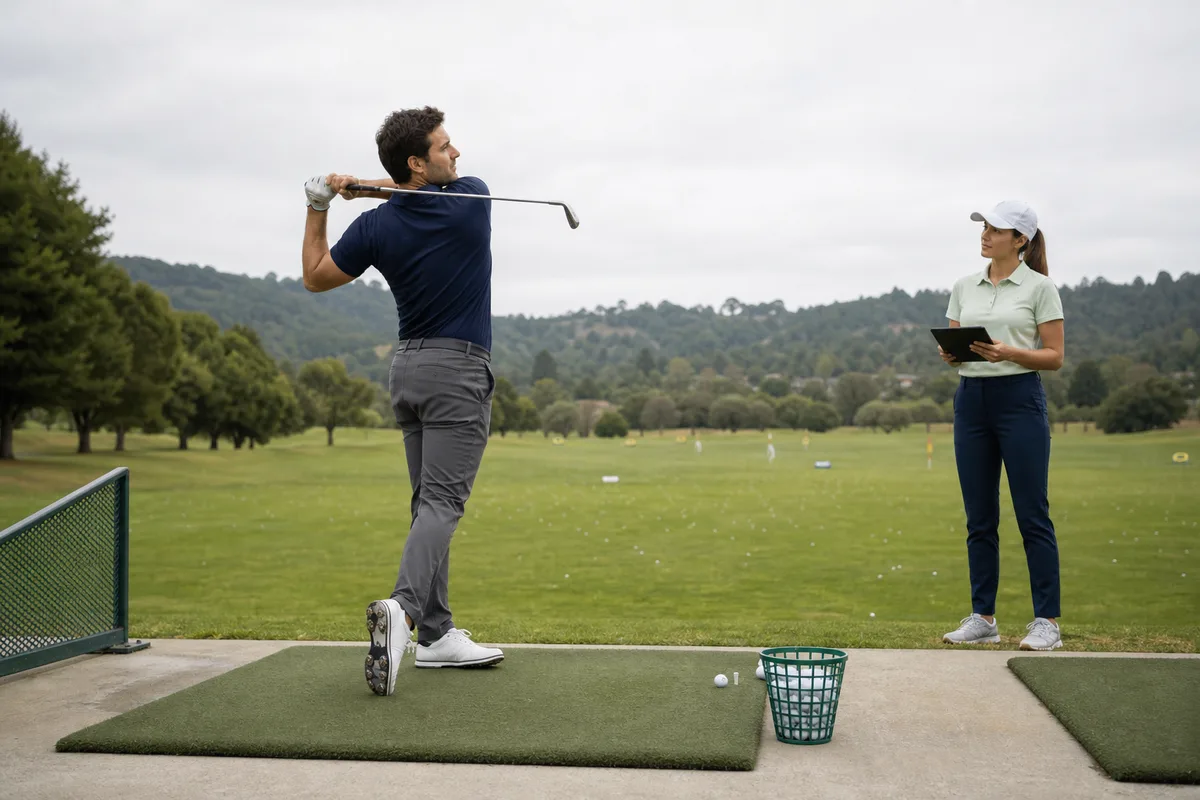
The problem is not that I never hit a good shot
I play golf regularly, usually twice a week on an executive nine-hole course. That should make me feel like a golfer with a dependable motion. Instead, I can hit one swing that feels free and balanced, then spend the next several holes searching for the person who made it.
The short course keeps me playing, which matters. It gives me real lies, targets, nerves, and consequences. It does not give me many chances to hit driver, fairway wood, or long irons. I can therefore become more familiar with golf without necessarily becoming more familiar with every full swing in my bag.
I want to work on my balance, finish, and follow-through. I also know those words are not a diagnosis. A finish can reveal what happened earlier in the motion, but posing beautifully after a poor strike is not a swing fix. That is where a qualified instructor belongs: helping me identify the cause, choosing one priority, and making sure the drill fits my swing rather than a generic picture.
I am borrowing the habit from running
I have become consistent with running because I stopped treating every workout like a verdict. I put in the miles each week. Some runs feel light, some feel slow, and the useful result appears across the accumulation.
Golf practice has not always worked that way for me. A good bucket can make me think I solved the swing. A poor bucket can make me want to change grip, posture, takeaway, transition, wrist hinge, and possibly my name. That emotional range is entertaining, but it is not a program.
The motor-learning research gives me a sensible direction. A systematic review of golf studies found support within the available evidence for distributed practice, an external focus of attention, gradually increasing practice variation, and tasks matched to the golfer's current ability. The authors also warn that many studies are small and often use novice putting tasks, so I am treating those findings as design principles rather than a guaranteed formula for my full swing.
What I mean by a consistent swing
I am not trying to make every ball identical. Even excellent golf contains variation. I want a motion that produces a narrower family of outcomes and gives me a useful miss when contact is not perfect.
| Measure | What I record | What counts as progress |
|---|---|---|
| Balance | Can I hold the finish for three calm seconds? | A higher percentage without steering or slowing down. |
| Contact | Solid, playable, or poor using the same definition each week. | Fewer heavy, thin, and extreme-face strikes. |
| Start direction | Did the ball begin inside my chosen window? | A tighter pattern, not one perfect flag shot. |
| Course result | Playable full swings, penalties, and recovery shots. | More ordinary next shots and fewer disasters. |
Distance is not the first score. If a calmer, balanced swing sends the ball a little shorter while the pattern tightens, I can build speed later. A ball that travels far enough and leaves another normal golf shot is doing useful work.
My eight-week plan at a glance
Build for 90 to 110 minutes
Warm up, establish a ten-ball baseline, practice the coach's one priority, expose the movement to longer clubs, and finish with a short transfer test.
Transfer for 75 to 100 minutes
Recalibrate briefly, change clubs and targets, simulate holes, add a small pressure game, and leave with one note for the next weekend.
Use my two executive rounds
Carry one cue at most, keep the pre-shot routine stable, and record playable swings rather than rebuilding mechanics after every miss.
Add one short weekday rehearsal
Ten quiet minutes of slow-motion swings, finish holds, or video review can preserve the idea. Missing this block does not erase the weekend plan.
Saturday morning: build the motion
- 10 minutes: warm up. I will use the site's dynamic golf warm-up, then make easy wedge and half-iron swings before asking for speed.
- 10 balls: take the baseline. I will use the same mid-iron, target window, and finish test each week. No drill and no rescue bucket first.
- 25 to 35 minutes: practice one lesson priority. I will work in short sets, pause between them, and use the exact checkpoint agreed upon with the instructor. If I cannot state the purpose in one sentence, the task is too crowded.
- 15 to 20 minutes: climb the bag. I will move from mid-iron to long iron or hybrid, fairway wood, and driver. The goal is exposure with balance, not ending the morning by trying to set a personal ball-speed record.
- 15 minutes: test the movement. I will change target or club every ball and play a few imaginary holes. This is the bridge to the site's fuller 45-ball course-simulation plan.
- 5 minutes: write the note. Best pattern, common miss, finish score, and the one task I will begin with Sunday.
The baseline comes before the lesson drill because I need an honest comparison. If I rehearse a feel for forty balls and then test it, I have measured short-term performance under ideal conditions. The more interesting question is whether the pattern returns after a night, a week, and a change of club.
My first drill is deliberately simple
A PGA coach's balanced-finish exercise gives me a clear starting test: make a committed swing, finish on the lead side, and hold the pose for a few seconds. Another PGA coaching article recommends a step-through drill for golfers who hang back on the trail foot. I am not automatically prescribing that second drill to myself. I will ask the instructor whether hanging back is actually my problem.
For the first set, I can make five slow rehearsals, ten half swings, ten three-quarter swings, and then ten fuller swings with a 7-iron. After every ball I will hold the finish for three seconds and watch the ball's start and curve. The finish is the checkpoint; the ball flight remains the task.
I will record one set from the same angle each Saturday, with the phone safely behind the hitting line. One short video can show whether the finish and tempo are changing. Filming every shot would turn practice into a production and tempt me to diagnose frames I do not understand.

Sunday morning: make the swing solve problems
Sunday should feel less tidy. I will begin with a short warm-up and a few repetitions of Saturday's priority, then spend most of the session changing the question.
- Hit one ball with a mid-iron, one with a hybrid or wood, and one with driver.
- Choose a fresh target and start line before every shot.
- Play six imaginary holes with one ball per decision.
- Finish with a five-ball test: three playable results and three balanced finishes is the opening standard.
- Stop before fatigue turns the final twenty balls into evidence against the first seventy.
The research term is contextual interference: practice becomes harder in the moment because the task keeps changing, but that difficulty can support retention and transfer. It is also possible to add too much variation too soon. That is why Saturday contains repetition and Sunday increases the uncertainty. I need enough stability to learn the movement and enough change to find out whether I own it.
Short game stays in the supporting cast
This is a full-swing project. I am not turning it into a combined driver, iron, wedge, bunker, and putting transformation. I will still spend ten or fifteen minutes chipping because I play a short course twice a week and because a small motion can expose tempo, contact, and commitment without requiring a full-speed swing.
If the instructor sees a connection between my short motion and full swing, that is useful. If not, chipping remains scoring practice and a pleasant way to finish. It does not get to create a second mechanical project.
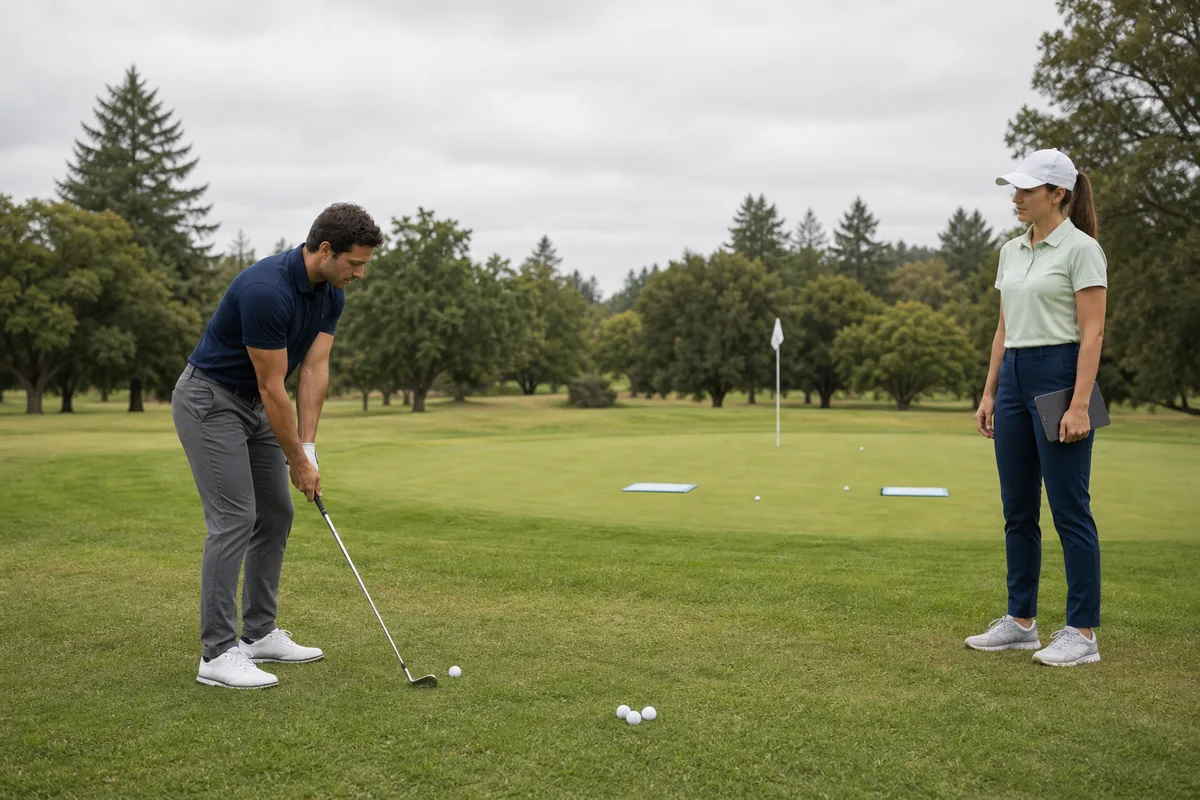
How I want lessons to fit the plan
I have been told to practice soon after a lesson, ideally the next day, while the feel and explanation are still familiar. I have not always arranged my schedule that way. This time I will book lessons only when I can protect a follow-up block within the next day or two.
At the end of each lesson, I want four things written in plain language:
- The one priority for the next practice block.
- One drill and the mistake that drill is meant to address.
- One ball-flight or contact clue that tells me it is working.
- One sign that means stop improvising and ask for help.
I am considering a lesson every few weeks during the eight-week block, but the instructor should help set the cadence. I do not need a new diagnosis every Saturday. I need enough supervised checkpoints to avoid rehearsing the wrong solution and enough unsupervised time to learn.
The scorecard that keeps one bad day in perspective
Each weekend starts with the same ten-ball 7-iron test. For every ball I mark four simple results: balanced finish, acceptable contact, start inside the window, and playable outcome. That gives me forty possible checks. I will also record the most common miss and save one video.
I will compare a four-session rolling average instead of chasing the best score. A 31 followed by a 22 is not proof that the plan failed. A month that moves from the low twenties into the high twenties, while the miss becomes less destructive, is evidence worth respecting.
On the executive course, I will count only the full swings that the course actually asks me to hit. How many left me a normal next shot? How many required a recovery or penalty? Did I keep one cue, or did I conduct a lesson with myself between the tee box and the ball? The on-course sample will be small, but it is the test that matters.
Eight weeks of achievable wins
| Week | Main job | A win I can control |
|---|---|---|
| 1 | Baseline and first lesson | Complete both sessions and define one priority. |
| 2 | Repeat the same drill | Use the same test without adding a new swing thought. |
| 3 | Long-club exposure | Hit every long club with a controlled finish, regardless of result. |
| 4 | Coach checkpoint | Bring the log and video instead of a vague report. |
| 5 | Pressure and variation | Complete the five-ball test without free retries. |
| 6 | Course transfer | Carry one cue and record playable full swings. |
| 7 | Keep or adjust | Change the plan only from evidence or coaching. |
| 8 | Retest and review | Repeat week one's test and write what actually improved. |
The rewards should celebrate the process. Four completed weekends can earn a longer practice morning at Peacock Gap. Eight can earn a lesson, round, or golf day that feels special. I do not have to buy something every time I behave like an adult with a calendar.
How I will keep it from disappearing on the course
The course is not where I want to audition six corrections. Before the round I will make a few progressive swings, choose one external target, and carry no more than one coach-approved feel. After a poor shot, I can name the result, choose the next play, and move on.
The range-to-course bridge lives in the Sunday session: one ball, a target, a routine, a consequence, and a new club next. My executive rounds then add real terrain and pressure. Because those rounds rarely call for driver or fairway wood, the weekend range sessions must keep those clubs visible. Otherwise I can improve at the golf I play most often while remaining a stranger to the golf I want to play next.
Presidio for repetition, Peacock Gap for a longer practice day
Presidio is the practical home base because it is close to me. Its official practice-facility page lists a driving range, a rotating putting and chipping green, rental clubs, and instruction from PGA professionals and other instructors. Hours can change for maintenance, so I will confirm them before building a morning around the range.
Peacock Gap is the destination session. I think it has the best practice area I have used around here: an all-grass range, maintained practice greens, and a chipping area. That makes it a good place for a multi-hour weekend visit once the weekly habit is real. It is a reward and a useful turf test, not an excuse to postpone ordinary practice until I have the perfect facility.
For more context on where each facility fits, my San Francisco public golf guide covers Presidio and the shorter courses I play regularly, while the Bay Area course-grass guide includes Peacock Gap's practice setup.
This article is my starting line
I have a plan now, but I do not have the result. That is the honest version of a journey article. I am going to run the eight-week block, take lessons, keep the small scorecard, and pay attention to what survives my actual rounds.
Then I will return with the useful part: the numbers, the drill I could stand repeating, the cue that became noise, the clubs that improved, and what happened when the range stopped giving me another ball. For now, the goal is less dramatic. Saturday morning, show up. Sunday morning, test it. Next week, do it again.
Sources
- PGA of America: a balanced finish as the end of the swing
- PGA of America: low-point, step-through, and complete-finish drills
- Frontiers in Sports and Active Living: systematic review of motor learning in golf
- Presidio Golf Course: official practice-facility information
- Peacock Gap Golf Club: official range, practice-area, and lesson information
More from this series
Practice and Golf Fitness
Part 2 of 8. Build a practice habit and support the movement that lets you enjoy more golf.
Keep reading
Here's another article you can enjoy
How to make range practice feel like golf: a 45-ball plan
Turn one bucket into targets, club changes, simulated holes, consequences, and a useful note for next time.
A 10-minute golf warm-up before a round
Dynamic movement and progressive swings so the first tee does not feel like the first rep.
Public golf in San Francisco
Five courses I have played, the hilly Presidio round still on my list, and how each fits a different day.