
Golf fitness
Golf exercises that actually support your game
The goal is not to make every gym movement look like a golf swing. Build general strength, learn to move quickly, keep useful ranges of motion, and arrive at the first tee ready to play.
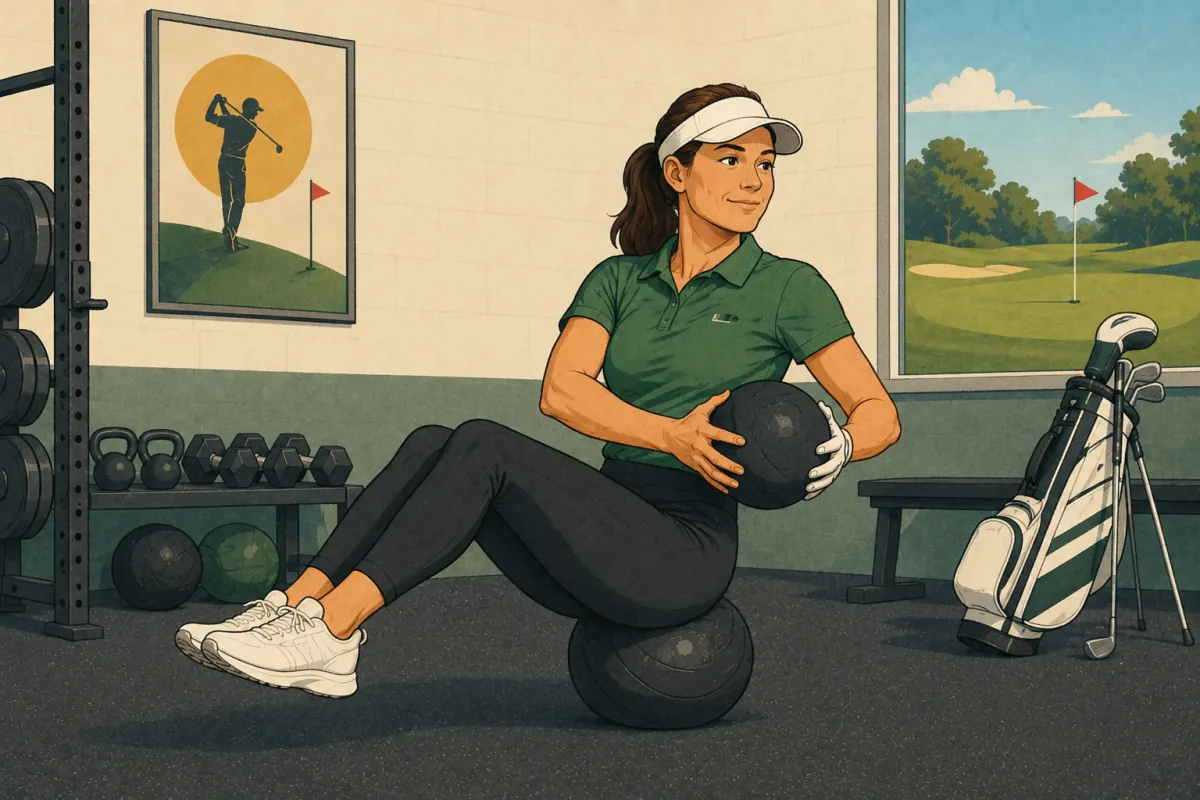
What should golf exercise improve?
A golf swing is a brief, coordinated expression of force. A round is also several hours of walking, bending, carrying, and repeating swings while concentration fades. A useful program therefore develops more than rotation.
Strength
Stronger legs, hips, trunk, back, and arms give you a larger physical reserve. Ordinary swings and long rounds can become a smaller percentage of what your body can handle.
Power
Power is the ability to express force quickly. Jumps, medicine-ball throws, and fast but controlled golf-specific movements can bridge strength training and swing speed.
Mobility
Useful ankle, hip, upper-back, and shoulder motion can make golf positions more comfortable. More flexibility alone does not automatically produce clubhead speed.
Capacity and balance
Walking fitness, single-leg control, and the ability to maintain posture help your movement hold together late in the round.
What the research suggests
A systematic review of resistance-training studies found improvements in clubhead speed and distance, with the strongest results tending to combine general resistance work and faster golf-specific exercise. Another large review found lower-body force and upper-body explosive strength were more closely related to clubhead speed than flexibility. These studies do not promise a certain number of yards, but they give us a better foundation than novelty drills and heroic rep counts.
A simple weekly structure
- Two full-body strength sessions: squat or lunge, hinge, push, pull, carry, and trunk control.
- One or two short power exposures: a few quality jumps or medicine-ball throws after warming up.
- Mobility most days if useful: five to fifteen minutes aimed at your actual limitations.
- A dynamic warm-up before golf: raise temperature, move the joints, and build swing speed gradually.
- Walking or aerobic work: enough to make eighteen holes feel less like an endurance event.
Start with the pieces you can repeat. A modest plan done for months will feed the golf bug better than a punishing golf workout abandoned after Tuesday.
Go deeper
Sources and further reading
- Resistance training and golf performance: systematic review
- Physical characteristics associated with clubhead speed: meta-analysis
- Physical determinants of golf swing performance: systematic review
- World Health Organization physical activity guidance
More from this series
Practice and Golf Fitness
Part 5 of 8. Build a practice habit and support the movement that lets you enjoy more golf.
Keep reading
Here's another article you can enjoy
How to make range practice feel like golf: a 45-ball plan
Turn one bucket into targets, club changes, simulated holes, consequences, and a useful note for next time.
How I am building a more consistent golf swing
I can make a good swing. My problem is finding it again. This is my eight-week weekend plan for better balance, a complete finish, useful lessons, and a motion that travels to the course.
Should you tee up an iron on a par 3? I have gone full T
I now tee every par-3 iron shot as low as I can. The consistent lie is worth taking, as long as turf practice keeps the rest of my iron game honest.