
Golf adventures
Public golf courses in San Francisco
San Francisco public golf can be championship-scale, nine holes in a city park, a round beside the Pacific, or a view of the Golden Gate Bridge that makes a bad score briefly irrelevant. These are the courses that have shown me the range of golf around the city.
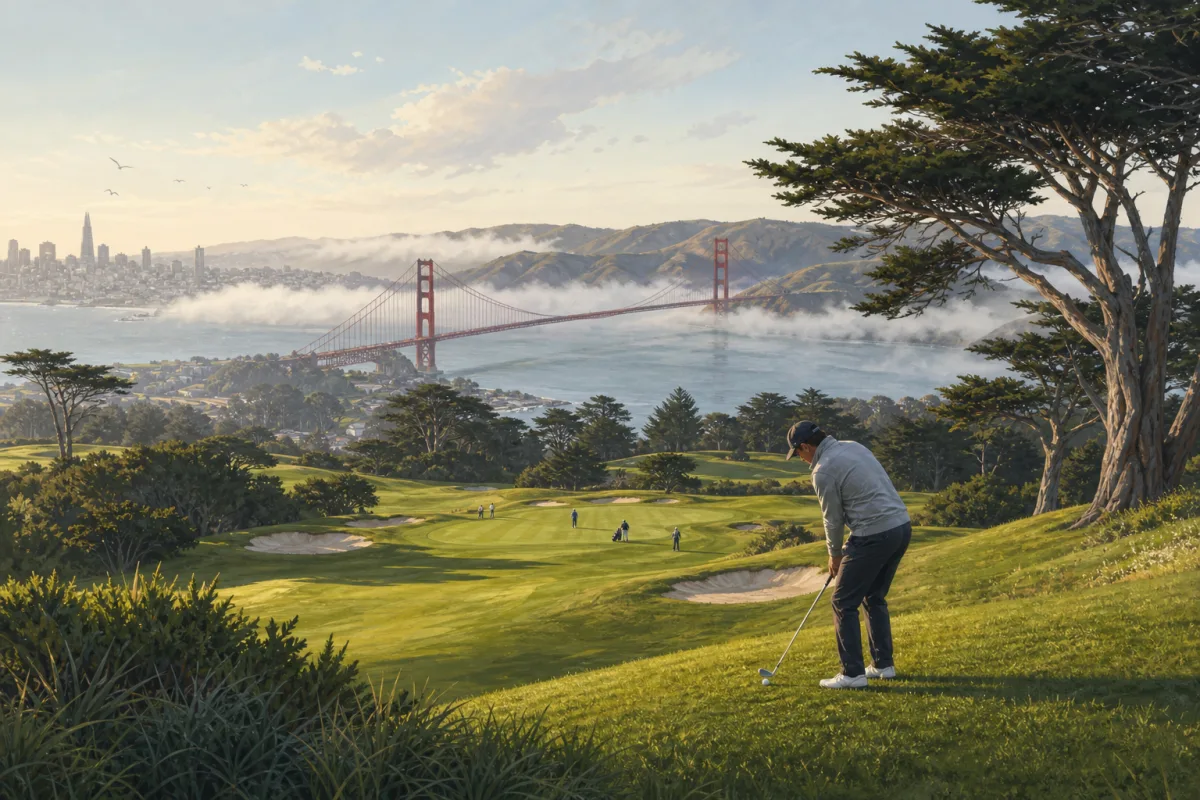
One reason I keep thinking about golf is that it gives me a reason to go outside and see familiar places differently.
San Francisco is already a city of hills, fog, ocean air, cypress trees, and views that can interrupt whatever else you thought you were doing. Add golf and the city becomes a collection of very different rounds. I have played Harding Park, Fleming, Lincoln Park, Golden Gate Park, and Sharp Park down in Pacifica. Presidio is still on my list.
They are all public. That matters to me. This is not an article about gates, invitations, or famous private courses that most people will never enter. It is about places where a golfer can make a tee time, bring a real and occasionally inconsistent game, and experience a different side of the Bay Area.
The quick guide: choose the round that fits the day
Harding Park
Choose it for the full championship-course feeling, cypress-lined holes, Lake Merced, and a round that feels like an event.
Fleming 9
Choose it for a shorter nine-hole round inside the Harding Park property without giving up a real-course feel.
Lincoln Park
Choose it for city history, uneven terrain, and the kind of Golden Gate Bridge view that belongs on the trip.
Golden Gate Park
Choose it for an approachable nine-hole par-3 round, short-game practice, or golf that fits into part of a day.
Sharp Park
Choose it for an affordable historic municipal course, Pacifica weather, and a rare public Alister MacKenzie design.
Presidio
Choose it for a challenging, hilly course through eucalyptus and Monterey pine - and book ahead.
Harding Park: the public round that feels like a major occasion
TPC Harding Park is the course to play when the group wants the biggest golf day. The 18-hole course sits on a gently rolling peninsula by Lake Merced, lined by Monterey cypress. It has hosted major professional events, including the 2020 PGA Championship, but it remains a San Francisco municipal facility open to the public.
That combination is the appeal. You can recognize the championship setting without needing to pretend you belong on television. The course asks for a complete day, some patience, and a swing that can survive looking down a tree-lined fairway.
For 18 holes in the city, Harding is so nice. I bought a remote-controlled electric push cart, and this is exactly the kind of course where it earns its place in the trunk. I still get the rhythm and fresh air of walking without spending the whole round pushing the weight of my bag.
Harding is cart-path-only year-round. That makes a riding cart less convenient when a shot finishes on the opposite side of a wide fairway: park, estimate which clubs might be needed, walk over, and hope the one left in the cart was not the answer. A remote push cart can travel with me as I walk, subject to the course's current equipment rules, which makes the round feel much more natural.
Harding uses demand-based pricing, so the rate changes with residency, date, and tee-time demand. The official FAQ says individual tee times may be made well in advance, and walk-ons are accepted but not guaranteed. For a planned golf day, I would reserve rather than build the morning around optimism.
The course also has a full practice facility. For a visitor who wants one recognizable public San Francisco round, Harding is the obvious place to start.
Fleming: nine holes without treating the round like a compromise
Fleming is a nine-hole course tucked inside the Harding Park property. It is over 2,100 yards, which means it is not simply nine repeated wedge shots. You still get to make choices, hit longer clubs, and play a compact round in the same Lake Merced and cypress environment.
I like what a course like Fleming represents. Not every round needs months of anticipation and an empty calendar. Nine holes can keep golf present in normal life. It can be the round after work, the lower-pressure option for a mixed group, or the day when 18 would turn enjoyment into an endurance contest.
Fleming also uses flexible pricing. Standard reservations may be booked seven days ahead, while advance reservations carry a separate booking fee. Check the current Fleming rates and policies before choosing the time.
Lincoln Park: the view is part of the scorecard
Lincoln Park occupies the city's northwestern corner, with views toward downtown, the Pacific, the Marin Headlands, and the Golden Gate Bridge. The golf course grew from a small early layout into a full 18 holes completed in 1917, and the land carries a much longer and more complicated city history.
This is not a manufactured resort view. It feels distinctly San Francisco: public land, hills, coastal air, a famous bridge appearing between golf shots, and a course woven into the city rather than separated from it.
The terrain is part of the round. A scenic course does not automatically mean an easy one, especially when lies and elevation keep changing. But Lincoln is the course I would show someone who wants to understand why golf in the city can be memorable even without resort polish.
As of July 2026, San Francisco Recreation and Parks lists standard 18-hole rates of $62 on weekdays and $69 on weekends, with lower resident, twilight, back-nine, junior, and senior options. Rates can change, so use the city's rates and tee-time page when planning.
Golden Gate Park: a smaller round that still feeds the golf bug
Golden Gate Park Golf Course is a nine-hole par-3 course near the western edge of the park. The official course description says its holes range from under 100 yards to 200 yards, with rolling terrain shaped by the area's sand-dune history and ocean breezes.
This is my go-to course, and I love it. The course reopened in February 2024 after an extensive renovation that widened playing corridors, added new greens and teeing options, improved irrigation and drainage, and brought more of the old sandy ground back into play. It now feels like a small course with real ideas rather than a place where nine short holes were merely squeezed into the park.
It is short, which is part of its purpose. I think of the round as roughly a mile and a half of walking, depending on the route between shots and tees. A beginner can play without needing driver distance on every hole. An experienced golfer can work on distance control and the short game. Someone with only part of a day can still walk a course, hit real shots, and leave feeling that golf happened.
There is also a small driving cage. The facility will not replace a giant practice complex, but that is not the job. Its job is to make golf fit inside city life.
The July 2026 posted rate is $45 on weekdays and $55 from Friday through Sunday for standard play, with discounted San Francisco resident and junior pricing. I would check the latest rate before going, then bring the part of my game that needs the most honest wedge practice.
Sharp Park: a San Francisco municipal course in Pacifica
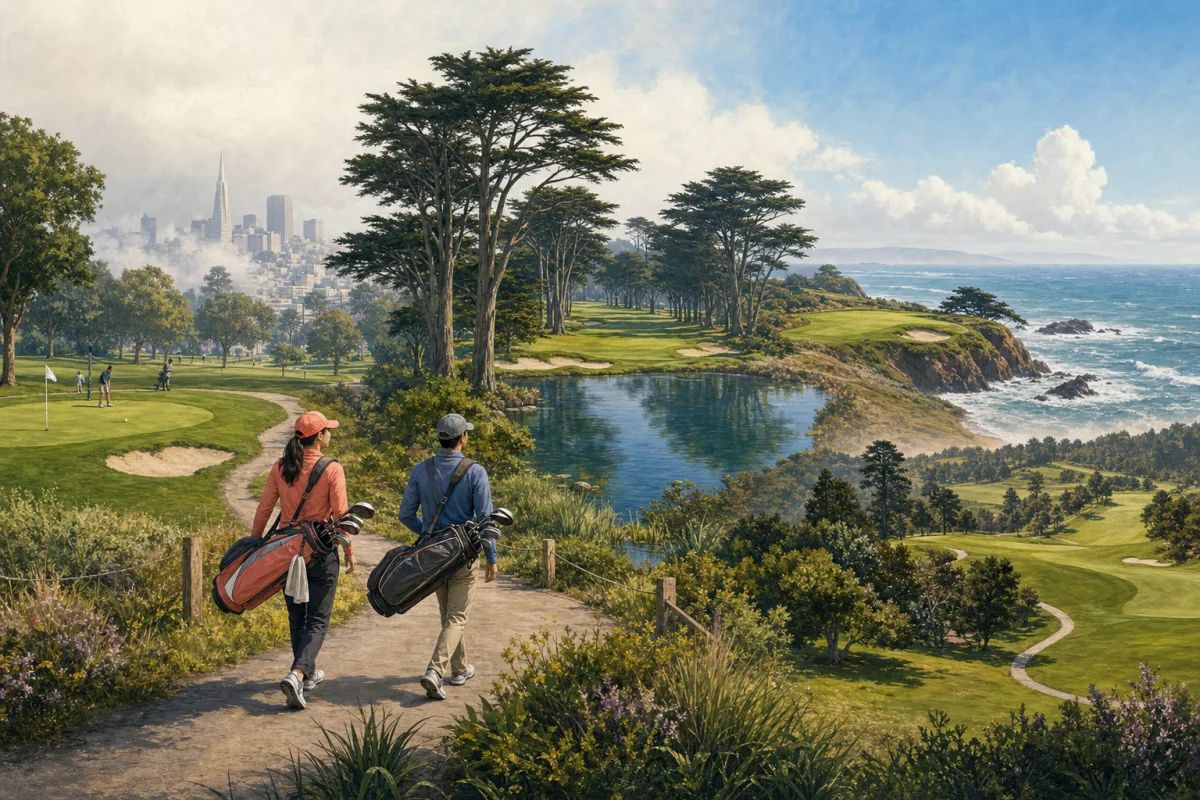
Sharp Park sits about 10 miles south of San Francisco in Pacifica, but it is managed by the San Francisco Recreation and Park Department. It opened in 1932 and was designed by Alister MacKenzie, making it one of the unusual places where everyday public golf intersects with a famous architectural name.
The city describes it as a walkable seaside-and-inland course with several holes wrapping around Laguna Salada. The Pacific Ocean, headlands, lake, and coastal conditions give it a character that does not feel like Harding, Lincoln, or a city par-3 course.
I do not think the point of playing Sharp Park is to tell yourself you are getting a discounted version of some private or resort course. It has its own public history, setting, and quirks. That is enough.
In July 2026, the posted standard rate is $78 on weekdays and $86 on weekends, with resident-card, back-nine, twilight, junior, and senior options. Tee times can be booked online or through the pro shop.
Presidio: the one I still want to play
I have not played Presidio yet, so I am describing why it is on my list rather than reviewing a round I have not taken.
The course is public and sits within the Presidio national park site. Its 18 holes run through eucalyptus and Monterey pine across what the course itself calls San Francisco's trademark hills. It plays about 6,500 yards from the back tees, with tight fairways and strategically placed bunkers.
The hills are part of why I have not treated it like an impulsive tee time. I know it will be a more demanding walk than some other local options, and I would rather choose the day than stumble into it. The booking window also rewards planning: public players can book standard times closer to the date, while advance reservations from 8 to 30 days carry a booking fee and loyalty members receive additional advance access.
As of July 2026, San Francisco city rates start at $85 walking Monday through Thursday after the course's April rate change, while Friday-through-Sunday pricing includes carts or push carts before twilight. Non-resident rates are higher, and the course adds a 3% park fee. Those details are exactly why I would use the official Presidio booking page rather than an old travel article.
Do San Francisco residents need the golf card?
If you live in San Francisco and play the city courses regularly, the resident card deserves a calculation. The city system and Harding Park offer lower cardholder rates, but the value depends on how often, where, and when you play.
Do not buy it because a discount sounds responsible. Compare the current card price with the actual difference on the courses and times you use. A golfer who plays Harding, Fleming, Lincoln, Sharp Park, or Golden Gate Park regularly may recover the cost differently from someone who plays only occasional twilight rounds.
A public-golf weekend around San Francisco
For a visitor or a local group trying to turn these courses into a small golf adventure, I would match the itinerary to energy rather than fame.
Short city golf
Start with Golden Gate Park or Fleming. Nine holes leaves room for travel, dinner, and the rest of San Francisco.
The main round
Play Harding Park for the championship setting or Presidio for a hilly parkland challenge. Do not schedule both as though walking is a minor detail.
Scenery and history
Choose Lincoln Park for the bridge-and-city experience or drive to Sharp Park for coastal municipal golf in Pacifica.
A second weekend can cover the courses left out. Golf adventures do not become more authentic simply because the group is exhausted.
What about Gleneagles?
I have not played Gleneagles yet, but it is too distinctive to leave off a San Francisco public-golf guide. This is a full-length, par-36 nine-hole course in McLaren Park, designed by Jack Fleming. The city describes tight fairways, tilted terrain, fast greens, and a layout that can be played as 18 from different tees. In other words, this is not the forgiving little nine-hole course someone may expect from the price.
The course itself is candid about having a fraction of the resources of the city's larger municipal courses. That rougher edge is part of the trade: current city rates are comparatively low, the golf is demanding, and the operation puts real emphasis on its community and its Scottish-style 19th hole. The course calls it one of its prime attractions. I have heard the more colorful version: Gleneagles can feel like a bar with a golf course attached.
There is also difficult history around the location. Contemporary news reports documented golfers being robbed on the course in 1995. I have heard that the area feels safer now, but I do not have current evidence strong enough to turn that impression into a promise. I would check in with the pro shop about present conditions, protect valuables as I would anywhere in the city, and judge the course as it operates today rather than freezing it in a story from three decades ago.
What pulls me toward it is the combination of challenge, affordability, personality, and a course that does not appear polished into sameness. I have been warned to bring extra balls. That sounds less like a review and more like a dare, which may be why I still want to go.
Why public golf belongs at the center of the story
Golf can make itself look inaccessible. Expensive equipment, private clubs, intimidating scorecards, and impossible highlight shots can convince a newer golfer that the real game is happening somewhere else.
Public courses push back on that idea. They may be famous, scruffy, polished, crowded, short, historic, hilly, windy, or all of those things in one round. The shared feature is that they give people a place to play.
That is what I enjoy about this collection around San Francisco. Harding can feel like a major venue. Golden Gate Park can fit into an afternoon. Lincoln can stop you with a bridge view. Sharp Park can send you into Pacifica wind on a MacKenzie design. Presidio can sit on the list until I am ready for the hills and lucky enough to get the tee time.
The golf bug does not need one perfect kind of course. It needs another reason to go outside.
Sources and booking links
- San Francisco Recreation and Parks: public golf courses
- San Francisco Recreation and Parks: current rates and tee times
- TPC Harding Park: public access, booking, and course FAQ
- Golden Gate Park Golf Course: official course information
- USGA: Golden Gate Park Golf Course renovation
- Sharp Park Golf Course: official course information
- Presidio Golf Course: official course overview
- Presidio Golf Course: rates and reservations
- San Francisco Recreation and Parks: Gleneagles course and rates
- Gleneagles Golf Course: course, community, and 19th hole
- San Francisco Examiner archive: 1995 robbery report
More from this series
Golf Adventures
Part 5 of 7. Plan memorable public-golf days and trips without losing sight of the people, walking, weather, and real-world budget.
Keep reading
Here's another article you can enjoy
Planning a Bandon Dunes golf trip
Courses, walking, weather, caddies, travel, and the budget conversation every group needs.
How I would plan a public golf trip to Monterey
Start with Poppy Hills and Pacific Grove, compare membership value, and choose one Monterey splurge without turning the trip into a financial endurance event.
How to travel with golf clubs: check them, ship them, or rent?
For a special golf trip, I want my own clubs. I compared shipping ahead with borrowing a hard case, checking the bag, and accepting rental clubs.