
Golf mobility
Golf stretches and mobility for a freer, more comfortable swing
Mobility gives you usable motion; flexibility describes how far tissues and joints can move. Golf needs enough of both, but more range is not automatically more speed.
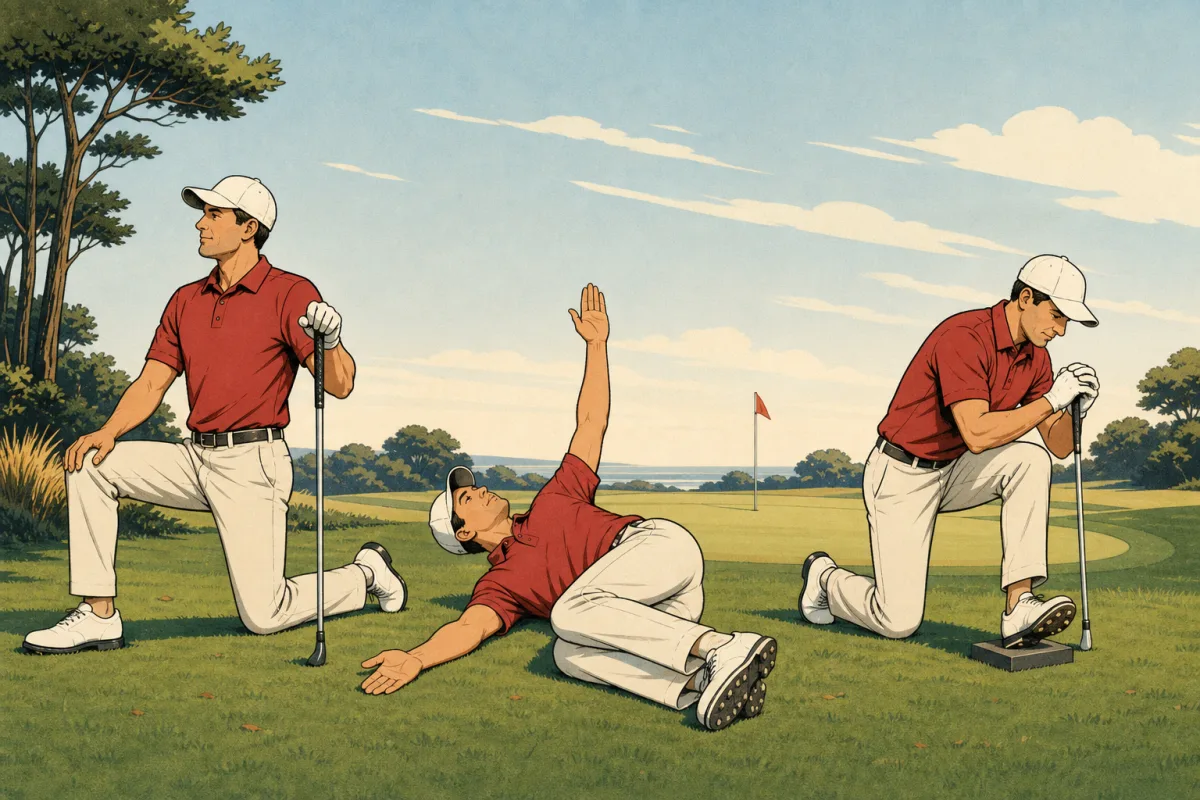
Stretch for a reason
A large review of physical qualities in golfers did not find flexibility significantly associated with clubhead speed. That does not make mobility unimportant. Useful motion can help you find positions without borrowing excessively from the lower back, and it may make setup, walking, and practice more comfortable. Speed still depends heavily on strength, power, and skill.
Where golfers commonly need motion
- Ankles: dorsiflexion helps the knees and hips move during squatting, walking, and uneven lies.
- Hips: internal and external rotation help the pelvis turn over relatively stable legs.
- Upper back: thoracic rotation lets the rib cage turn while the lumbar spine contributes less.
- Shoulders and lats: comfortable overhead and cross-body motion supports the arm path.
- Wrists and forearms: gentle range can be useful after computer work or heavy gripping.
A 10- to 15-minute golf mobility routine
Move slowly, breathe normally, and use a range that feels like mild tension rather than pain. Complete one round; repeat a second round where you feel genuinely limited.
1. Ankle rocks
Keep the heel down and drive the knee over the middle toes without collapsing the arch. Do 8-10 controlled repetitions per side.
2. 90/90 hip switches
Sit with both knees bent and rotate them side to side. Keep the movement small enough to control. Do 6 per side.
3. Half-kneeling hip-flexor stretch
Tuck the pelvis slightly and squeeze the glute of the kneeling side before drifting forward. Hold 30-45 seconds, twice per side.
4. Adductor rock-back
From hands and knees, extend one leg to the side and sit the hips back while keeping the spine long. Do 8 repetitions per side.
5. Open-book rotation
Lie on your side with hips and knees bent. Rotate the top arm and rib cage open while keeping the knees together. Do 6-8 repetitions per side without forcing the lower back.
6. Wall lat stretch
Place the hands on a wall or bench, hinge the hips back, and let the chest lower between the arms. Hold 30 seconds, twice.
Before golf or after golf?
Before play, favor dynamic movement and progressive swings. Small studies in golfers found that long passive static-stretch routines immediately before hitting could reduce speed, distance, or consistency, while dynamic warm-ups improved several measures. That does not mean every brief stretch ruins a round. Broader research suggests short static holds of 60 seconds or less per muscle have only trivial effects when they are part of a complete warm-up.
Use longer holds after golf, later in the day, or in a separate mobility session. Before the first tee, keep moving and follow any brief stretches with active turns and progressively faster practice swings.
Do not force rotation through the lower back
The lumbar spine can move, but a golf swing asks it to manage high forces while the hips and upper back rotate. Low-back pain is the most commonly reported golf injury, and its causes are multifactorial. Treat sharp pain, radiating symptoms, numbness, or persistent soreness as a reason to stop and seek qualified care, not as tightness to stretch harder.
Heading to the course? Use the 10-minute dynamic golf warm-up. Building a broader program? Start with the complete golf exercise guide.
Sources and further reading
- Physical characteristics and clubhead speed: meta-analysis
- Acute effects of static stretching on golf performance
- Dynamic stretching and golf performance
- Static stretching within a complete warm-up: review
- Low-back pain and golf biomechanics: systematic review
More from this series
Practice and Golf Fitness
Part 7 of 8. Build a practice habit and support the movement that lets you enjoy more golf.
Keep reading
Here's another article you can enjoy
How to make range practice feel like golf: a 45-ball plan
Turn one bucket into targets, club changes, simulated holes, consequences, and a useful note for next time.
How I am building a more consistent golf swing
I can make a good swing. My problem is finding it again. This is my eight-week weekend plan for better balance, a complete finish, useful lessons, and a motion that travels to the course.
Should you tee up an iron on a par 3? I have gone full T
I now tee every par-3 iron shot as low as I can. The consistent lie is worth taking, as long as turf practice keeps the rest of my iron game honest.