
Golf legends
Seve Ballesteros: the golfer who made recovery shots feel heroic
New golfers should know Seve because he made imagination part of the game. He won like a legend, escaped trouble like an artist, and helped give European golf a new sense of possibility.
Who was Seve?
Severiano "Seve" Ballesteros was a Spanish champion whose golf was forceful, inventive, emotional, and unmistakably his. He won five major championships: The Open in 1979, 1984, and 1988, plus the Masters in 1980 and 1983. His 50 wins on what is now the DP World Tour remain the tour record, according to its official career history.
Those facts establish greatness. They do not quite explain why people still talk about him with such affection. Seve made a round feel unstable in the best way. A drive into trouble did not end the story. A difficult lie gave him another chance to see something the rest of us had missed.
A golf education built by the sea
Ballesteros came from Pedreña, a village on Spain's northern coast. The DP World Tour's official player profile says he learned the game at seven with a cut-down 3-iron on the beach near his home. The Open's account of his childhood adds that, while working as a young caddie, he practiced in unconventional places because access to the course was limited.
It is tempting to turn that beginning into a tidy myth: beach golf created the creative genius. Real careers are never that simple. Still, the setting helps us understand the player. He learned to produce shots from imperfect ground, with limited equipment, by experimenting with face angle, trajectory, and feel. His later golf never looked confined to one approved swing.
The 1979 Open and the car-park birdie
His first major captured the Seve experience in one hole. During the final round of the 1979 Open at Royal Lytham & St Annes, his tee shot on the 16th went right into a temporary car park. After a free drop, he found the green and made birdie. The Open's official history of the championship describes the sequence as the iconic moment of the round.
The story sometimes becomes evidence that Seve could simply ignore accuracy. That misses the hard part. The drive created trouble; the recovery required a rules decision, a clear picture, execution, and then a made putt. Creativity did not make the mistake disappear. It gave him a way to continue competing after it.
That distinction matters for new golfers. A heroic recovery is memorable, but the useful skill is staying observant after the original plan fails.
The 1984 putt that looked like Seve
For all the recovery shots attached to his name, his most famous image came from a putt. At St Andrews in 1984, Ballesteros birdied the 18th and produced the fist pump, smile, and full-body release that became inseparable from his career. The Open's 40th-anniversary account records that Seve considered it the greatest moment of his sporting life.
The shot itself was conventional. The feeling was not. Golf often trains players to contain everything: no reaction, no panic, no visible hope. Seve showed that deep competitive emotion and great golf could occupy the same frame.
Why beginners connect with him
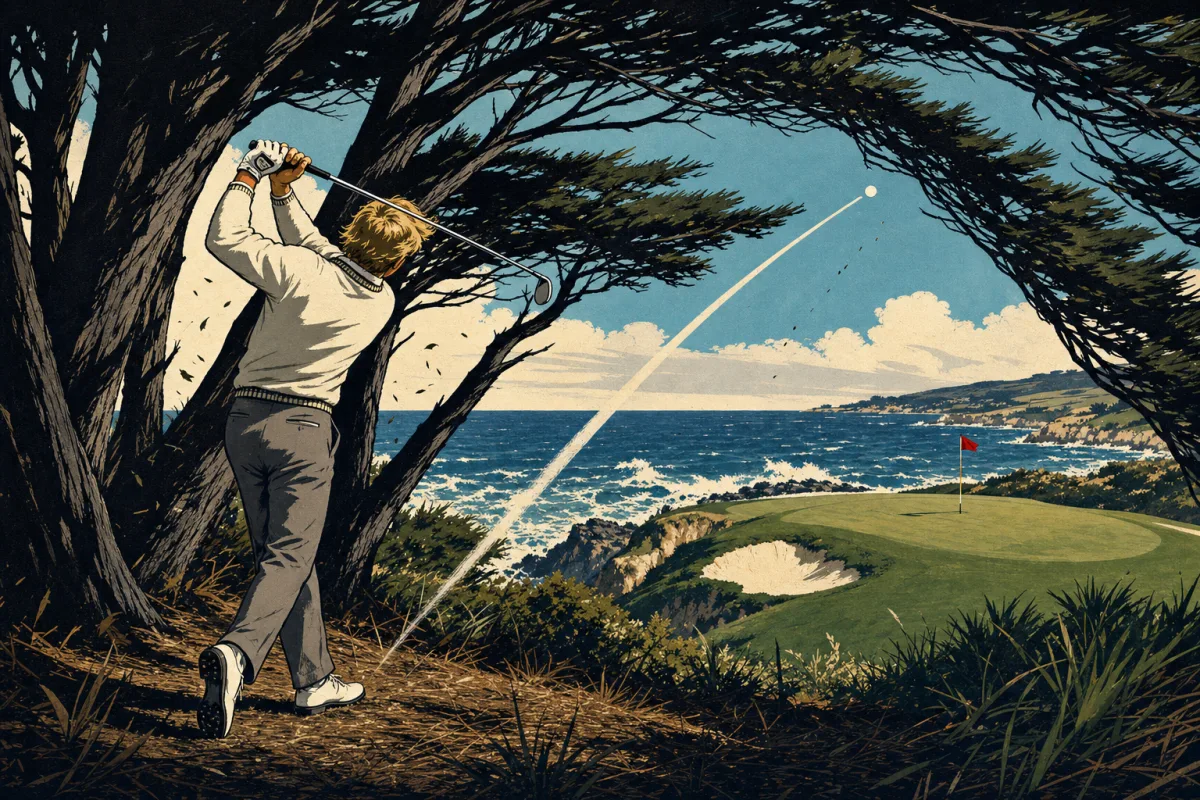
Most new golfers spend time in trees, rough, sand, and strange places that were not part of the plan. Watching only fairway-and-green golf can make those misses feel like evidence that you are playing a different sport. Seve turned difficult places into stages.
He is reassuring without being easy to imitate. His example says a hole remains alive after a poor shot. It does not say the smartest play is always the narrowest gap between two trees.
The short game lesson
Seve's legacy is a reminder that golf is not only full swings from perfect positions. Touch, imagination, and commitment matter. The World Golf Hall of Fame describes imagination, touch, and determination as central to a career of more than 70 professional victories.
A newer golfer can practice that side of the game without attempting impossible shots:
- Chip one ball to the same hole with a wedge, short iron, and hybrid.
- Land several shots on one spot using different trajectories.
- Practice a low punch that returns the ball to safety.
- Change the lie instead of placing every practice ball perfectly.
- Before swinging, name the easiest exit and the ambitious option.
The point is to expand your vocabulary. You may still choose the simple sentence.
Recovery golf is judgment, not just nerve
When you find trouble, ask three questions in order:
- What is guaranteed? Identify the widest route back to a playable position.
- What is possible? Consider the lie, branch height, carry, and where a miss would finish.
- What does the hole require? A match-play gamble, a casual experiment, and a medal-round decision may not deserve the same shot.
Seve had the technique to make extraordinary options realistic. For the rest of us, imagination includes recognizing when sideways is the clever shot. Commitment should begin after the risk has earned a yes.
The Ryder Cup spark
Ballesteros also changed the emotional scale of European team golf. He debuted in 1979, the first Ryder Cup in which players from continental Europe joined the former Great Britain and Ireland side. Across eight appearances, he won 20 points in 37 matches. With fellow Spaniard José María Olazábal, he formed the event's most productive partnership: 12 points from 15 matches.
In 1997 he captained Europe to victory at Valderrama in Spain, the first Ryder Cup staged in continental Europe. The official Ryder Cup retrospective presents him not just as a great player but as one of the event's defining European figures.
For a new golfer, Ryder Cup footage reveals something stroke-play highlights can hide: golf can be communal, partisan, nervous, and openly joyful. Seve did not invent that energy, but he gave Europe a face for it.
What to watch for
- His first survey of the lie. Before the famous swing, watch how much information he gathers.
- The face and trajectory. Notice how open or shut the club appears and how high he needs the ball to launch.
- His finish. Recovery swings are often shaped around the space available, not a textbook pose.
- His short-game variety. Similar distances do not automatically produce the same club or flight.
- His match-play presence. In Ryder Cup clips, watch the reaction of partners, opponents, and crowds as well as the shot.
Good starting points are The Open's official histories of the 1979 car-park escape and the 1984 St Andrews victory. Together they show the two images that explain his appeal: escape and celebration.
What Seve leaves a new golfer
Learn a basic motion, certainly. Practice contact, choose sensible targets, and take the safe route often enough to keep the round moving. But do not let technical work convince you that golf has only one correct picture.
The course will eventually put your ball on bare ground, behind a branch, below your feet, or beside a bunker lip. That is not an interruption of golf. It is golf asking whether you can observe, imagine, and choose.
Seve Ballesteros was great because he won five majors and more tournaments than most players could dream of entering. He remains magnetic because, even at the highest level, he made the game look available to invention.
Put a little of that creativity into your own practice with the 45-ball course-simulation plan. The goal is not to copy Seve's miracle shots; it is to see more than one way forward.
Sources and further reading
- DP World Tour: Seve Ballesteros career history
- DP World Tour: Seve Ballesteros player profile
- The Open: Ballesteros wins his first Open Championship in 1979
- The Open: Forty years since Seve's 1984 St Andrews victory
- Ryder Cup: Seve's eight appearances and 1997 captaincy
- World Golf Hall of Fame: Seve Ballesteros
More from this series
The Wider Golf World
Part 4 of 4. Follow the golf bug into course knowledge, history, and the details that make the game interesting.
Keep reading
Here's another article you can enjoy
So many clubs! What pros carry and beginners actually need
The 14-club rule, wedge gaps, woods, hybrids, putters, and the case for giving every club a job.
Golf course grass types: the full guide to greens, fairways, and rough
Where bentgrass, Bermuda, Poa annua, ryegrass, fescue, and zoysia usually grow - and what each surface means for the next shot.
Bay Area golf course grass: a public-course guide
Compare documented turf at Harding Park, Corica Park, Baylands, and Metropolitan, plus the excellent all-grass practice area at Peacock Gap.