
Golf course turf
Golf course grass types: the full guide to greens, fairways, and rough
Bentgrass is strongly associated with putting greens, while Bermuda, ryegrass, fescue, Poa annua, and zoysia can appear in several parts of a course. The useful question is not only “What grass is this?” but “Where is it growing, how closely is it cut, and what lie did it give me?”
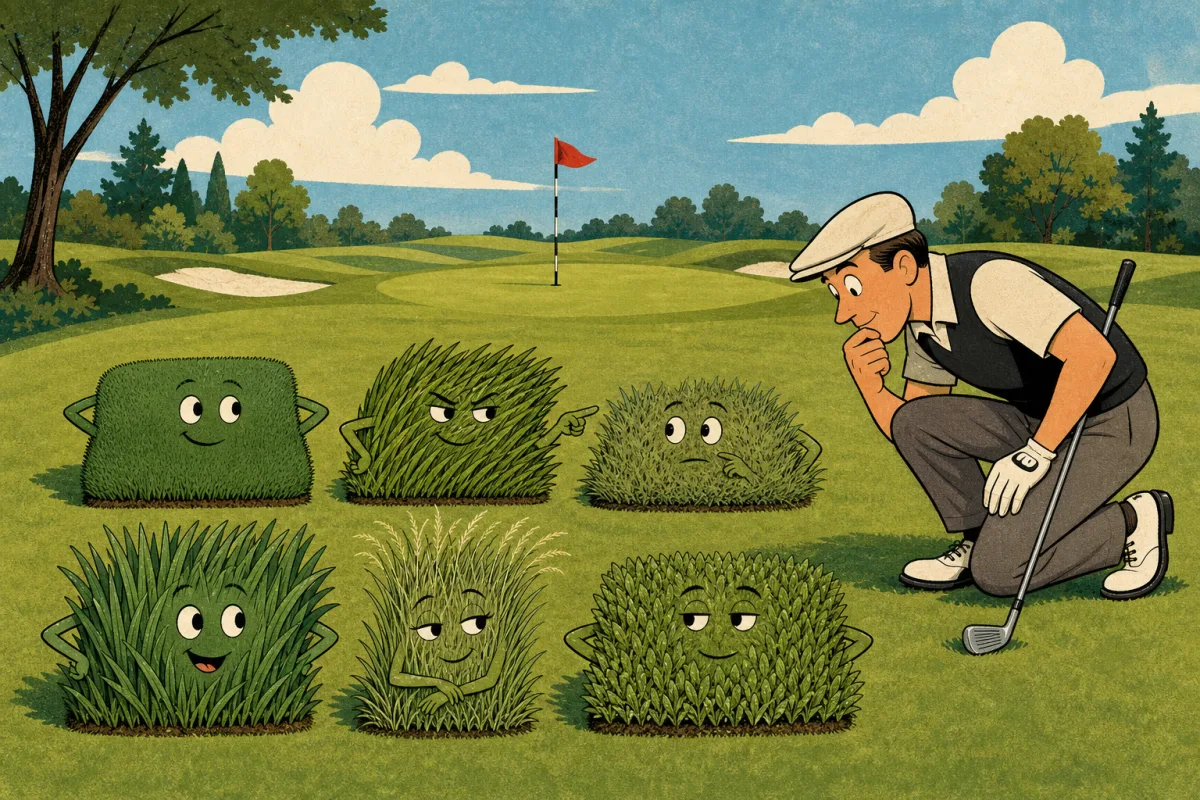
What grass is used on golf course greens, fairways, and rough?
There is no universal turf blueprint. A species can be a prized putting surface at one course, part of a mixed fairway at another, and an unwanted visitor somewhere else. Still, these are the roles golfers most commonly encounter.
| Grass | Greens | Tees and fairways | Rough and natural areas |
|---|---|---|---|
| Creeping bentgrass | Very common in cool climates | Common on some cool-season courses | Less common as maintained rough |
| Bermudagrass | Common in warm regions with green-specific cultivars | Very common in warm regions | Common and durable |
| Poa annua | Common on many cool, coastal courses | Often present alone or in a mix | Can spread into maintained rough |
| Perennial ryegrass | Unusual as the primary putting grass | Common and often used for overseeding | Common where quick recovery matters |
| Fine fescue | Used on some links greens or in mixes | Common on links-style courses | Common in wispy naturalized areas |
| Zoysiagrass | Possible, but less common than fairway use | Known for dense fairway and tee turf | Used in suitable warm and transition climates |
What is the best grass for a golf course?
There is no single best grass for every golf course. A superintendent is not choosing turf by color alone. Climate, winter survival, heat, water availability, shade, traffic, disease pressure, mowing height, and maintenance resources all affect which grasses can produce a healthy playing surface. A species that thrives on one course may struggle a few hundred miles away.
The job also changes from one part of the hole to another. A green needs turf that survives extremely low mowing and provides a reliable roll. Tees must recover from concentrated divots. Fairways need a useful lie across a large area. Rough needs durability and enough density to create a penalty without making every missed fairway a lost-ball expedition. Naturalized areas may prioritize habitat and lower inputs over a manicured lie.
Cool-season and warm-season turf
Cool-season grasses grow most actively during milder spring and fall weather. Bentgrass, annual bluegrass, ryegrass, and many fescues belong to this broad group. Warm-season grasses such as bermudagrass and zoysiagrass thrive during hotter months and may turn tan or dormant when temperatures fall. The USGA notes that seasonal growth changes can alter firmness, color, recovery, and even green speed without meaning the maintenance team has done something wrong.
Transition-zone courses sit between those climates, which makes turf selection especially complicated. Some facilities overseed dormant warm-season turf with ryegrass to retain green color and playable coverage during cooler months. In the San Francisco Bay Area, mild coastal weather has traditionally favored perennial ryegrass, Poa annua, and creeping bentgrass, although water concerns are driving more interest in warm-season turf.
Bentgrass
Creeping bentgrass is common on cooler-climate putting greens because it tolerates very close mowing and can form a dense, smooth surface. It is also used on tees and fairways at some cool-season courses. When golfers praise a pure, quick bentgrass green, they are seeing both the plant and the result of careful mowing, irrigation, aeration, topdressing, and disease management.
Bermudagrass
Bermudagrass loves heat, spreads aggressively, and recovers well from traffic. Standard and hybrid varieties are widely used on tees, fairways, and rough in warm regions; specialized dwarf and ultradwarf cultivars can be maintained as putting greens. Its grain can influence chips and putts: shots traveling into the grain may slow or catch, while shots with the grain can release faster.
Poa annua
Poa annua, or annual bluegrass, appears throughout many cool-season courses. It can be the desired putting surface rather than merely a weed, and it also lives in tees, fairways, collars, and rough, often mixed with ryegrass or bentgrass. Its many local types do not all behave the same. Seedheads and uneven growth can change texture during the day, which is one reason golfers sometimes perceive more wobble on afternoon putts.
Ryegrass
Perennial ryegrass establishes quickly, tolerates traffic, and is commonly used on tees, fairways, and rough. Warm-climate courses may plant it over dormant Bermuda during cooler months. Its upright growth can produce a clean fairway lie, although dense ryegrass rough may sit down around the ball. It is not a typical primary putting-green species.
Fescue
Fescue is a family of grasses rather than one uniform playing surface. Fine fescues are associated with links golf and can be used on greens, tees, and fairways, either alone or in mixtures. Taller fescues and fine fescues can also appear in maintained rough. The long, waving naturalized fescue beside a fairway may need fewer inputs, provide habitat, look beautiful, and still punish a crooked shot with a search party.
Zoysia
Zoysiagrass is a warm-season turf that forms a dense surface and is best known in golf for tees and fairways, especially through the transition zone. Some cultivars can be used on greens, and zoysia can also serve as rough where the climate fits. The ball can sit up invitingly in a closely mown zoysia fairway, while dense zoysia rough can grab the club more than a new golfer expects. It generally establishes and recovers more slowly than bermudagrass.
How grass changes the shot
On the putting green
Look at texture and slope before blaming the species. Moisture, mowing, growth through the day, aeration, and foot traffic all affect speed and smoothness. On grainy grass, look for a slight sheen or darker appearance as an additional clue, then let the practice green tell you how much it matters that day.
Around the green
Before a chip, notice whether the ball is sitting up, nestled down, or resting against the direction of growth. Into dense or sticky grass, a lofted club may lose speed quickly. From a clean tight lie, a lower-running shot can remove some uncertainty.
From fairway and rough
A fairway species matters less than the lie in front of you. Check how much grass sits between the clubface and ball. From heavy rough, use enough loft, shorten the swing when needed, and choose a realistic target instead of expecting normal fairway spin.
How to identify what you are playing on
Start with the course, not a plant-identification guess. The scorecard, maintenance blog, tournament fact sheet, or superintendent update may list each surface. Ask the golf shop if it does not. Courses renovate, introduce new cultivars, and manage mixed stands, so an old third-party directory can be confidently wrong.
Then use the practice area as the practical test. Roll putts from several distances, chip both with and against the growth, and notice whether full shots sit up or settle down. Knowing the species is interesting. Knowing what today's surface will do to the next shot is useful.
Why new golfers should care
You do not need to become a superintendent to play better golf. Knowing that turf changes by climate, season, course area, and maintenance helps explain why a chip that worked last week might behave differently today. Arrive early enough to roll putts and hit a few chips. That small field test is more useful than memorizing every species, but now at least the grass has names.
Sources and further reading
- USGA: Know Your Turf
- USGA: Selecting the right grass
- USGA: Why golf courses play better at certain times of year
- USGA: Turfgrass and climate in the San Francisco Bay Area
Keep exploring the course with our guide to making range practice feel more like golf, or read about Seve Ballesteros and the imagination behind great recovery shots.
More from this series
The Wider Golf World
Part 1 of 4. Follow the golf bug into course knowledge, history, and the details that make the game interesting.
Keep reading
Here's another article you can enjoy
How to make range practice feel like golf: a 45-ball plan
Turn one bucket into targets, club changes, simulated holes, consequences, and a useful note for next time.
Bay Area golf course grass: a public-course guide
Compare documented turf at Harding Park, Corica Park, Baylands, and Metropolitan, plus the excellent all-grass practice area at Peacock Gap.
Golf course food worth planning around: three Bay Area stops
Some golf food gets me through the back nine. Some gives the group a reason to stay. These three public Bay Area stops show why access, timing, and the job of the meal matter as much as the menu.