
Golf Adventures
How to travel with golf clubs: check them, ship them, or rent?
I have not flown with my clubs yet. Before my first special golf trip, I want to decide whether familiar clubs belong in a hard case at the airport, on a truck ahead of me, or safely at home while I pretend rental irons feel the same.
My answer before my first trip
If I am traveling specifically to play a course I care about, I want my own clubs. I know the distances, the grips, the weight, the putter, and the particular collection of expectations I have attached to them. Rental clubs solve a logistics problem by creating a golf problem.
My first choice is probably to ship the bag if the quote and delivery window make sense. My economical fallback is to borrow my buddy's hard travel case and check it. He has flown with his clubs that way and chose the rigid protection for a reason.
I would rent only for a casual round attached to some other trip, or if bringing my own clubs made the entire schedule unreasonable. If I sought out the course, I want to bring my best stuff.
The three real choices
| Option | Best reason to choose it | Main tradeoff |
|---|---|---|
| Check the clubs | The bag travels with the flight and may count as ordinary checked baggage under the airline's current policy. | I carry the case through the airport and accept airline handling, baggage claim, and damage risk. |
| Ship ahead | The clubs can travel door to door while I skip an oversized case at the terminal and in the rental car. | I need an earlier packing deadline, a reliable receiving location, and a quote that fits the trip. |
| Rent at the course | There is no travel-case problem at all. | I play a meaningful round with unfamiliar lofts, shafts, grips, and putter. |
Checking clubs can be the economical answer
Checking the bag is attractive when I have a direct flight, a manageable baggage fee, a hard case I can borrow, and a vehicle at the destination that can swallow the case. The same plan becomes less attractive with connections, strict weight limits, a tiny rental car, or several golfers all arriving with rigid cases.
Airline sports-equipment rules change, and the ticket matters. Before booking, I would read the exact golf-bag policy for the carrier and fare I am buying. I would check the weight limit, bag count, oversize treatment, case requirements, and whether the airline limits liability for a soft-sided cover.
The U.S. Department of Transportation says airlines are responsible for repairing or reimbursing passengers for baggage damaged while under the airline's control, subject to liability limits and exceptions. That is useful protection, not a substitute for packing well. I would photograph the clubs and case before departure, keep the baggage tag, inspect the case promptly after arrival, and report visible damage through the airline's process.
Hard case or soft cover?
Why I lean toward the hard case
A rigid shell protects against crushing and sharp impacts in a way fabric cannot. That is why my friend chose one. For a first trip with clubs I care about, borrowing his case gives me more confidence without making me buy another large object before I know how often I will use it.
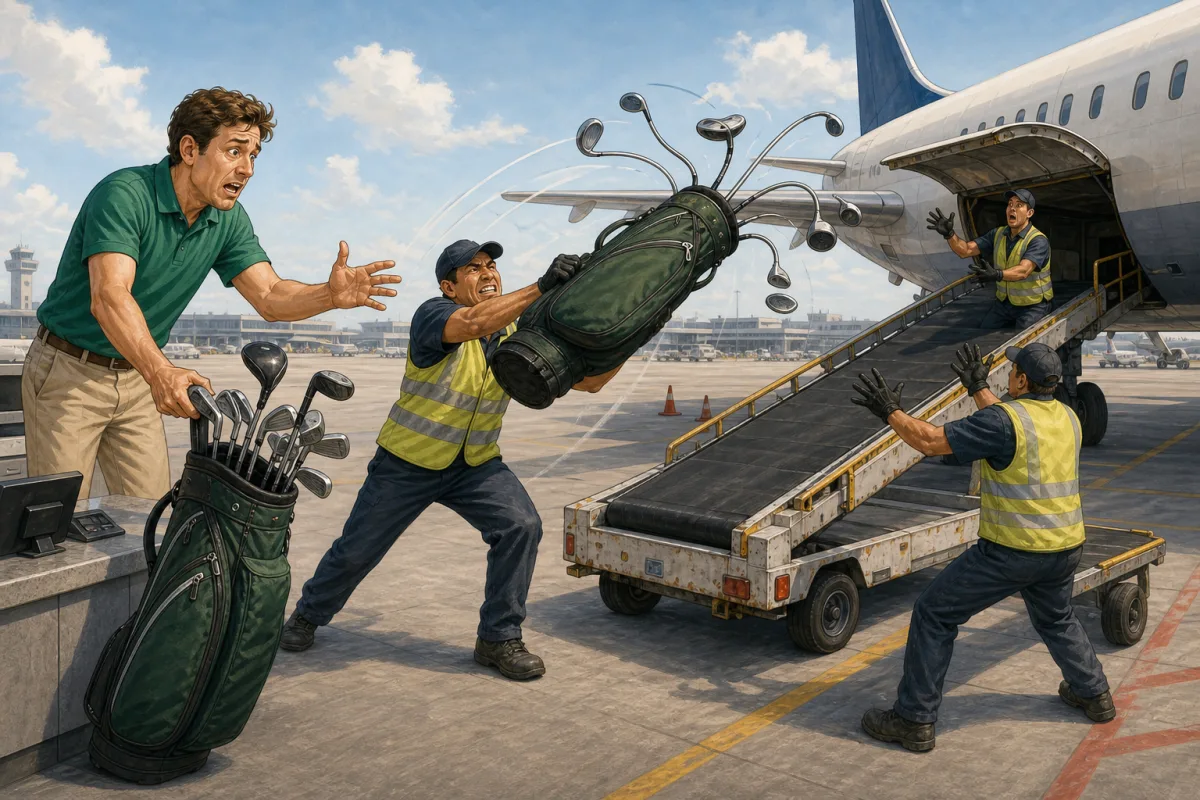
The downside is physical comedy. A hard case is heavy, long, awkward, and unapologetic about occupying a trunk. I need to count its empty weight against the baggage limit and make sure it fits the vehicle waiting on the other side.
Where a soft cover makes sense
A padded soft cover is easier to store and often easier to fit into a car. Good internal straps, substantial padding around the club heads, and a stiff-arm style support can improve protection. It still cannot become rigid when another bag lands on it.
I would treat a soft cover as the more convenient packing system, not the more protective one. The airline's current terms may also treat soft-sided sporting cases differently when damage is involved, which is another reason to read before flying.

How I would pack either case
- Check the total weight first. The case, golf bag, clubs, shoes, balls, and optimistic number of emergency layers all count.
- Protect the longest clubs. A stiff-arm support can take the first vertical impact instead of a driver shaft.
- Cushion the club heads. Weave towels or soft clothing around them so they cannot repeatedly strike one another.
- Secure the bag inside the case. Internal movement turns every bump into a second collision.
- Follow the club maker's instructions. Some golfers remove adjustable wood heads for travel; if I do, I need the wrench and a protected place for every part.
- Put identification inside and outside. A detached exterior tag should not make the bag anonymous.
- Photograph the packed bag. A quick record is useful if I need to describe what was inside and how it was protected.
I would not turn the golf case into a loophole for unrelated luggage. Extra clothes add weight, can complicate a claim, and make it harder to see whether I am still within the carrier's sporting-equipment rules.
Shipping buys a calmer airport
A dedicated golf-club shipping service separates the clubs from my passenger itinerary. Depending on the provider and service level, the plan may include door-to-door transport, tracking, delivery notifications, and optional coverage. I still need a travel cover, hard case, or suitable box, and the bag needs to be ready before I leave.
The convenience is easy to imagine. I arrive at the airport without a long case, collect ordinary luggage, and choose a rental car based on people rather than club geometry. That can matter even more when several golfers are traveling together.
The tradeoff moves from baggage claim to the calendar. I need to ship early enough, confirm that the hotel, resort, course, or other destination can receive the bag, track it, and leave room for disruption. I would schedule delivery before the first tee time, not on the morning of it.
Shipping also needs a real quote. A starting price is not my price. Distance, speed, pickup, case, insurance, and return timing all matter. I would compare the round-trip shipping total with the airline fee, the value of borrowing a hard case, and any larger rental car required by the checked case.
When renting actually wins
Rental clubs make sense when golf is a spontaneous extra rather than the purpose of the trip. One casual round, no checked luggage, a tight schedule, and a course with a suitable rental set can make leaving the bag at home completely rational.
That is not the trip I am imagining. If I am traveling to Bandon, Monterey, Scottsdale, or another course I deliberately chose, I do not want the first three holes to become a fitting session. I want to know which iron I trust and how far it normally goes.
Rental availability also needs confirmation. "The course rents clubs" does not tell me whether the set is available in my handedness, shaft, length, or preferred configuration. I would reserve it, not assume it will materialize beside the first tee.
The decision I would make today
I would price two plans for the same dates.
- Shipping plan: door-to-door round-trip quote, delivery at least a little early, confirmed receiving location, and coverage that reflects the bag's value.
- Checked plan: my exact airline's current fee and rules, my buddy's borrowed hard case, total packed weight, connection count, and a rental car that can carry it.
If shipping is reasonably close after I count the airport and car inconvenience, I ship. If the difference is large and the flight is direct, I borrow the hard case and check it. That choice may change by trip, which is more useful than pretending one method always wins.
Renting remains the emergency exit. It gets me onto the course, but it is not how I want to begin a trip built around golf.
A five-minute pre-trip check
- Read the airline or shipping provider's current terms for the exact itinerary.
- Confirm the packed dimensions and weight.
- Confirm the case fits the destination vehicle.
- Confirm who will receive a shipped bag and when.
- Keep photos, serial numbers, receipts, baggage tags, and tracking details accessible.
- Give the clubs time to arrive before the tee time.
The point is not to eliminate every risk. It is to make the risk visible before the clubs disappear behind a counter or into a truck.
My clubs are part of the trip
I understand the freedom of walking through an airport with no golf case at all. I also understand what it would feel like to stand on a special first tee with a putter I met ten minutes earlier.
For a course I care about, my own clubs are coming. I will probably ship them if the schedule and quote cooperate. If they do not, my buddy's hard case is waiting. Either way, I want the bag at the destination before I begin celebrating how easy golf travel is.
Sources and further reading
More from this series
Golf Adventures
Part 3 of 7. Plan memorable public-golf days and trips without losing sight of the people, walking, weather, and real-world budget.
Keep reading
Here's another article you can enjoy
Planning a Bandon Dunes golf trip
Courses, walking, weather, caddies, travel, and the budget conversation every group needs.
How I would plan a public golf trip to Monterey
Start with Poppy Hills and Pacific Grove, compare membership value, and choose one Monterey splurge without turning the trip into a financial endurance event.
Half Moon Bay: Ocean Course or Old Course?
I choose the Ocean Course for a first friend outing, then test that instinct against the two public-course designs.